We began our day talking about H2O, then discussed the Titanic, then the Hindenburg, then Mark Twain, then helium, then steam and how the Titanic was powered, which led to evaporation and the water cycle, and how snow is formed. We then studied snow under the microscope, and then onto the Plasma ball and conductivity.
Lily has spent the last couple days with Maya here, and they’re exploring together. They discussed the Titanic yesterday, describing the 4 stacks,

A 4th state of matter, you say? Well, yes, actually.. and it is all around us as it turns out.
-
Plasma (from Greek πλάσμα, “anything formed”) is one of the four fundamental states of matter, the others being solid, liquid, and gas. A plasma has properties unlike those of the other states.
How do plasma balls work?
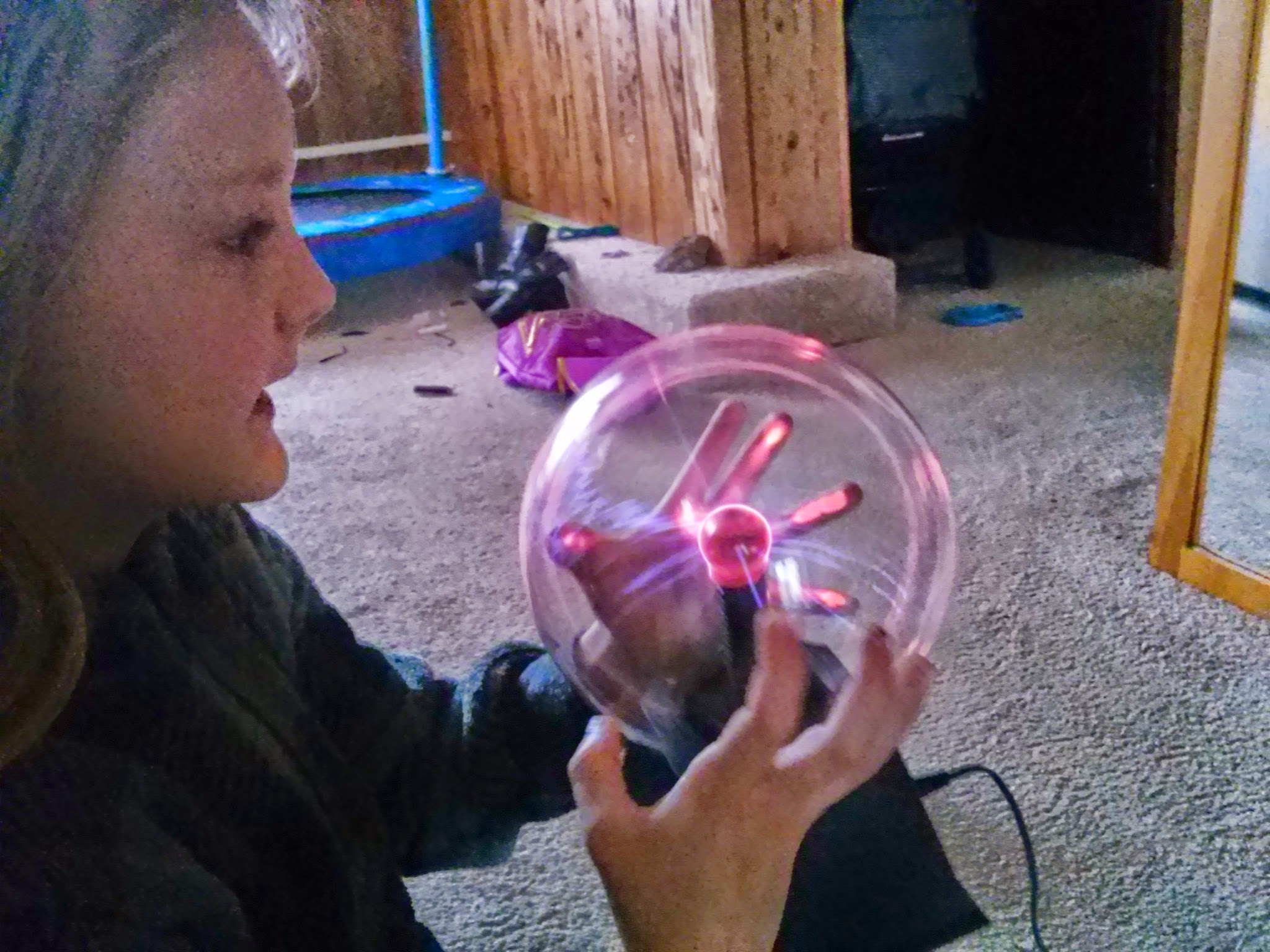
A Plasma Ball is very simply, really! It is basically made up of a glass ball, filled with an inert gas (a gas that won’t chemically react) such as neon or argon, with a smaller glass sphere in the middle that contains the electrode (the electrical conductor that connects a metallic conductor, with a nonmetallic conductor – the outside glass ball!).
When we turn it on, a voltage is induced in the electrode, which creates an electric field inside the ball. This field means that electrons can travel from the negatively charged electrode, trying to make a neutral charge elsewhere, which just happens to be at the glass ball. At the same time, another oscillating voltage is induced, which changes the electric field, and changes the electrons’ paths, making what we can see as the ‘wavey’ trail as the plasma arms.
As it is explained now, you wouldn’t actually see the trails. This is where the gas comes into play! When the voltage is great enough, the electrons break free from the electrode and begin to accelerate, always gaining energy. As the electrons pass through the gas, they give it a charge, ionizing it. The path that an electron travels, makes it easier for other to follow it, and so there is a continuous tendril from the electrode to the glass ball. While this happens, the excited atoms must lose energy, and do so by emitting a photon, which we can see as light. The color of it depends on what gas is used, normally an eerie purple color.
A plasma can be created by heating a gas or subjecting it to a strong electromagnetic field applied with alaser or microwave generator. This decreases or increases the number of electrons, creating positive or negative charged particles called ions,[2] and is accompanied by the dissociation of molecular bonds, if present.[3]
The presence of a non-negligible number of charge carriers makes plasma electrically conductive so that it responds strongly to electromagnetic fields. Like gas, plasma does not have a definite shape or a definite volume unless enclosed in a container. Unlike gas, under the influence of a magnetic field, it may form structures such as filaments, beams and double layers.
Plasma is the most abundant form of ordinary matter in the Universe, most of which is in the rarefiedintergalactic regions, particularly the intracluster medium, and in stars, including the Sun.[4][5] A common form of plasmas on Earth is seen in neon signs.
Much of the understanding of plasmas has come from the pursuit of controlled nuclear fusion and fusion power, for which plasma physics provides the scientific basis.
Common plasmas
Plasmas are by far the most common phase of ordinary matter in the universe, both by mass and by volume.[18] Essentially, all of the visible light from space comes from stars, which are plasmas with a temperature such that they radiate strongly at visible wavelengths. Most of the ordinary (or baryonic) matter in the universe, however, is found in theintergalactic medium, which is also a plasma, but much hotter, so that it radiates primarily as X-rays.
In 1937, Hannes Alfvén argued that if plasma pervaded the universe, it could then carry electric currents capable of generating a galactic magnetic field.[19] After winning the Nobel Prize, he emphasized that:
In order to understand the phenomena in a certain plasma region, it is necessary to map not only the magnetic but also the electric field and the electric currents. Space is filled with a network of currents which transfer energy and momentum over large or very large distances. The currents often pinch to filamentary or surface currents. The latter are likely to give space, as also interstellar and intergalactic space, a cellular structure.[20]
By contrast the current scientific consensus is that about 96% of the total energy density in the universe is not plasma or any other form of ordinary matter, but a combination ofcold dark matter and dark energy. Our Sun, and all stars, are made of plasma, much of interstellar space is filled with a plasma, albeit a very sparse one, and intergalactic spacetoo. Even black holes, which are not directly visible, are thought to be fuelled by accreting ionising matter (i.e. plasma),[21] and they are associated with astrophysical jets of luminous ejected plasma,[22] such as M87’s jet that extends 5,000 light-years.[23]
In our solar system, interplanetary space is filled with the plasma of the Solar Wind that extends from the Sun out to the heliopause. However, the density of ordinary matter is much higher than average and much higher than that of either dark matter or dark energy. The planet Jupiter accounts for most of the non-plasma, only about 0.1% of the mass and 10−15% of the volume within the orbit of Pluto.
Dust and small grains within a plasma will also pick up a net negative charge, so that they in turn may act like a very heavy negative ion component of the plasma (see dusty plasmas).
| Artificially produced | Terrestrial plasmas | Space andastrophysicalplasmas |
|---|---|---|
|
|
|