We started exploring 24 hour format today, which she’s heard of it before, but only slightly. It remains without relevance at this point, but the concept was part of some game she wanted to play, and so she was exposed. Russ will look for an opportunity to bring it into something of interest for Lily.
Concepts Understood:
- We discussed how 12 hour requires the identification of am/pm and how 24 does not.
- She identified length of current day, split by half (right now, we are experiencing more dark than light hours per day, but she mentioned how at some times of the year we end up with about 12 hours of light and 12 hours of dark. This led to a discussion of the equinoxes.
- She asked how many years into the future (suggested she remembered 500 and then corrected to 500k) when our days would be 36 hours long, as that is when she wants to live. She wants longer days… I think she’d be well suited.
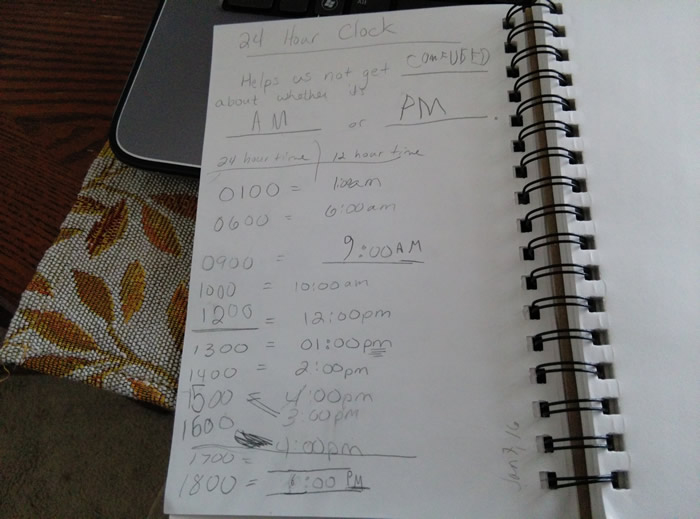
As we worked through the following exercise, she struggled quite a bit. Initially, she made perfect sense of the content, until we crossed over into 1300+ and her comprehension seemed to waiver. We went rounds a few times, me thinking she just couldn’t identify the pattern, but then she took the notebook, and flipped back to the previous page (the image above) and said, “That would be another half a day!”. Turns out, she wasn’t struggling with the pattern to figure out what hundred hour correlates with the 12/hour format, she was trying to work out in her head how much longer her days would be if she got to live when they were 36 hours long.
After declaring that she’d get a day and a half to our present days, she turned back to the exercise (image below) and finished it without any further challenge.
24 hour time remains irrelevant for her, except in concept/awareness. She can determine what hundred to am/pm given either the hundred, the 12 hour time, or neither, just requested to calculate “2 hours later” and identify both methods of reference.
http://www.bbc.co.uk/bitesize/ks2/maths/shape_space/time/play/
http://askville.amazon.com/day-year-world-12-hours-daylight/AnswerViewer.do?requestId=55469766
what day of the year does all the world have the same 12 hours of daylight and darkness? |
|
what day of the year has 12 hours of daylight and 12 hours of darkness in the entire world?
|
Vernal and Autumnal equinoxes
|
This is usually around 20 March and 22 September. It varies due to a year being roughly 6 hours longer than 365 days. The leap year day keeps the equinox dates from shifting throughout the year.
The equinox is when the axis of the Earth neither points toward or away from the Sun. The terminator between night and day crosses the north and south poles, so all parts of the Earth have the same length day and night. More information can be found at the link below. |

Technically, there isn’t one.
|
It is true that on the March (March 20th or 21st) and September (September 22nd or 23rd) Equinox (Latin for equal night) there is roughly equal amounts of daylight and darkness everywhere on the earth. However, due to the Earth’s atmosphere’s refraction of light, on these days there is, at minimum, 14 minutes more daylight than darkness (more at the poles). What the equinox actually measures is the exact moment the sun crosses the Earth’s equator. On eqinox charts they actually list the exat time it happens on the given day.
There are days on which there are exactly twelve hours of daylight and darkness, but they are dependent on a location’s distance from the equator and do not all happen on the same day. That day is called the equilux (Latin for equal light). So, since it seems to be common to ignore those 14 minutes, you’re fully welcome to consider the equinox the days of even light and dark, but if you want to be a stickler, there you have it.  Paraphrased from the more techie: US Naval Observatory: Day and night are not exactly of equal length at the time of the March and September equinoxes. The dates on which day and night are each 12 hours occur a few days before and after the equinoxes. The specific dates of this occurrence are different for different latitudes. On the day of an equinox, the geometric center of the Sun’s disk crosses the equator, and this point is above the horizon for 12 hours everywhere on the Earth. However, the Sun is not simply a geometric point. Sunrise is defined as the instant when the leading edge of the Sun’s disk becomes visible on the horizon, whereas sunset is the instant when the trailing edge of the disk disappears below the horizon. These are the moments of first and last direct sunlight. At these times the center of the disk is below the horizon. Furthermore, atmospheric refraction causes the Sun’s disk to appear higher in the sky than it would if the Earth had no atmosphere. Thus, in the morning the upper edge of the disk is visible for several minutes before the geometric edge of the disk reaches the horizon. Similarly, in the evening the upper edge of the disk disappears several minutes after the geometric disk has passed below the horizon. The times of sunrise and sunset in almanacs are calculated for the normal atmospheric refraction of 34 minutes of arc and a semidiameter of 16 minutes of arc for the disk. Therefore, at the tabulated time the geometric center of the Sun is actually 50 minutes of arc below a regular and unobstructed horizon for an observer on the surface of the Earth in a level region. For observers within a couple of degrees of the equator, the period from sunrise to sunset is always several minutes longer than the night. At higher latitudes in the northern hemisphere, the date of equal day and night occurs before the March equinox. Daytime continues to be longer than nighttime until after the September equinox. In the southern hemisphere, the dates of equal day and night occur before the September equinox and after the March equinox. In the northern hemisphere, at latitude 5 degrees the dates of equal day and night occur about February 25 and October 15; at latitude 40 degrees they occur about March 17 and September 26. On the dates of the equinoxes, the day is about 7 minutes longer than the night at latitudes up to about 25 degrees, increasing to 10 minutes or more at latitude 50 degrees. Chart of Times: www.erh.noaa.gov/box/equinox.html |
|
| Sources: http://en.wikipedia.org/wiki/Equinox,http://aa.usno.navy.mil/faq/docs/equinoxes.ph |
AND IN CONTRAST
Everything you need to know: December solstice 2015
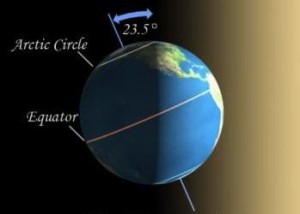
December solstice
|
|
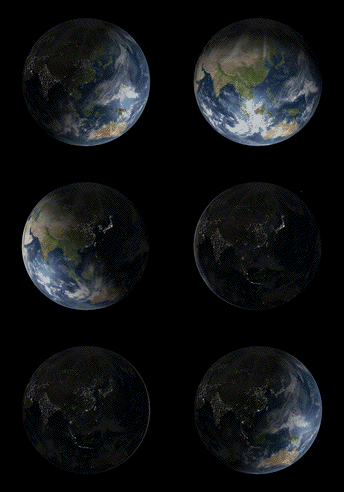
Late dawn. Early sunset. Short day. Long night. For us in the Northern Hemisphere, the December solstice marks the longest night and shortest day of the year. Meanwhile, on the day of the December solstice, the Southern Hemisphere has its longest day and shortest night. This special day is coming up on Tuesday, December 22 at 4:48 UTC (December 21 at 10:48 p.m. CST). No matter where you live on Earth’s globe, a solstice is your signal to celebrate. Follow the links below to learn more about the 2015 December solstice.
When is the solstice where I live?
What is a solstice?
Where should I look to see signs of the solstice in nature?
Why doesn’t the earliest sunset come on the shortest day?
Day and night sides of Earth on the December 2015 solstice

When is the solstice where I live? The solstice happens at the same instant for all of us, everywhere on Earth. In 2015, the December solstice comes on December 21 at 10:48 p.m. CST. That’s on December 22 at 4:48 Universal Time. It’s when the sun on our sky’s dome reaches its farthest southward point for the year. At this solstice, the Northern Hemisphere has its shortest day and longest night of the year.
To find the time in your location, you have to translate to your time zone. Click here to translate Universal Time to your local time.
Just remember: you’re translating from 4:48 UT on December 22. So for most of the world’s eastern hemisphere – Europe, Africa, Asia, Australia and New Zealand – the December solstice actually comes on December 22. For example, if you live in Perth, Australia, you need to add 8 hours to Universal Time to find out that the solstice happens on December 22, at 12:48 p.m. AWST (Australian Western Standard Time).
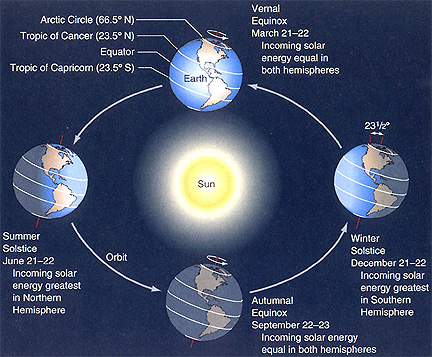
What is a solstice? The earliest people on Earth knew that the sun’s path across the sky, the length of daylight, and the location of the sunrise and sunset all shifted in a regular way throughout the year. They built monuments such as Stonehenge in England – or, for example, at Machu Picchu in Peru – to follow the sun’s yearly progress.
But we today see the solstice differently. We can picture it from the vantage point of space. Today, we know that the solstice is an astronomical event, caused by Earth’s tilt on its axis, and its motion in orbit around the sun.
Because Earth doesn’t orbit upright, but is instead tilted on its axis by 23-and-a-half degrees, Earth’s Northern and Southern Hemispheres trade places in receiving the sun’s light and warmth most directly. The tilt of the Earth – not our distance from the sun – is what causes winter and summer. At the December solstice, the Northern Hemisphere is leaning most away from the sun for the year.
At the December solstice, Earth is positioned in its orbit so that the sun stays below the north pole horizon. As seen from 23-and-a-half degrees south of the equator, at the imaginary line encircling the globe known as the Tropic of Capricorn, the sun shines directly overhead at noon. This is as far south as the sun ever gets. All locations south of the equator have day lengths greater than 12 hours at the December solstice. Meanwhile, all locations north of the equator have day lengths less than 12 hours.
For us on the northern part of Earth, the shortest day comes at the solstice. After the winter solstice, the days get longer, and the nights shorter. It’s a seasonal shift that nearly everyone notices.


Where should I look to see signs of the solstice in nature? Everywhere.
For all of Earth’s creatures, nothing is so fundamental as the length of daylight. After all, the sun is the ultimate source of all light and warmth on Earth.
If you live in the northern hemisphere, you can notice the late dawns and early sunsets, and the low arc of the sun across the sky each day. You might notice how low the sun appears in the sky at local noon. And be sure to look at your noontime shadow. Around the time of the December solstice, it’s your longest noontime shadow of the year.
In the Southern Hemisphere, it’s opposite. Dawn comes early, and dusk comes late. The sun is high. It’s your shortest noontime shadow of the year.
Why doesn’t the earliest sunset come on the shortest day? The December solstice marks the shortest day of the year in the Northern Hemisphere and longest day in the Southern Hemisphere. But the earliest sunset – or earliest sunrise if you’re south of the equator – happens before the December solstice. Many people notice this, and ask about it.
The key to understanding the earliest sunset is not to focus on the time of sunset or sunrise. The key is to focus on what is called true solar noon – the time of day that the sun reaches its highest point, in its journey across your sky.
In early December, true solar noon comes nearly 10 minutes earlier by the clock than it does at the solstice around December 22. With true noon coming later on the solstice, so will the sunrise and sunset times.
It’s this discrepancy between clock time and sun time that causes the Northern Hemisphere’s earliest sunset and the Southern Hemisphere’s earliest sunrise to precede the December solstice.
The discrepancy occurs primarily because of the tilt of the Earth’s axis. A secondary but another contributing factor to this discrepancy between clock noon and sun noon comes from the Earth’s elliptical – oblong – orbit around the sun. The Earth’s orbit is not a perfect circle, and when we’re closest to the sun, our world moves fastest in orbit. Our closest point to the sun – or perihelion – comes in early January. So we are moving fastest in orbit around now, slightly faster than our average speed of about 30 kilometers (18.5 miles) per second. The discrepancy between sun time and clock time is greater around the December solstice than the June solstice because we’re nearer the sun at this time of year.

The precise date of the earliest sunset depends on your latitude. At mid-northern latitudes, it comes in early December each year. At northern temperate latitudes farther north – such as in Canada and Alaska – the year’s earliest sunset comes around mid-December. Close to the Arctic Circle, the earliest sunset and the December solstice occur on or near the same day.
By the way, the latest sunrise doesn’t come on the solstice either. From mid-northern latitudes, the latest sunrise comes in early January.
The exact dates vary, but the sequence is always the same: earliest sunset in early December, shortest day on the solstice around December 22, latest sunrise in early January.
And so the cycle continues.
Bottom line: In 2015, the December solstice comes on December 21 at 10:48 p.m. CST. That’s December 22 at 4:48 UT. It marks the Northern Hemisphere’s shortest day (first day of winter) and Southern Hemisphere’s longest day (first day of summer). Happy solstice, everyone!