This conversation has associated posts here & here.
_________________________________________________
Ok, so, I already suspected it, but, now I know. Lily seems to have inherited a fun trick from Russ.
With music coming from both of us, and it being aural and sight, it’s not a surprise she’s exhibiting a somewhat natural knack for it.. But this was unexpected. He and I can both identify pitch clearly, as well as hear all tones, harmonic and enharmonic. So can she. He and I can both identify instruments, parts, and orchestrate/compose for them. One of us does it a lot more than the other, but that’s another story.

Last night, Lily went skipping down the hall upstairs and stopped at the top of the stairs, pointed at the doorbell (we have the chime type with pipes). While pointing, she hummed the 4 note melody ours plays. Then off she went.
Me being intrigued, and not knowing whether she was dead on or not without a reference point, had to test by tapping the pipes. Russ was in the kitchen, I suppose smirking to himself because, I assume, he already knew what I had to find out. Of course, she was dead on. Pitch and meter.
Yeah, well, so maybe a fluke… this was the second or third time she’d demonstrated this little trick. Heh, so maybe.
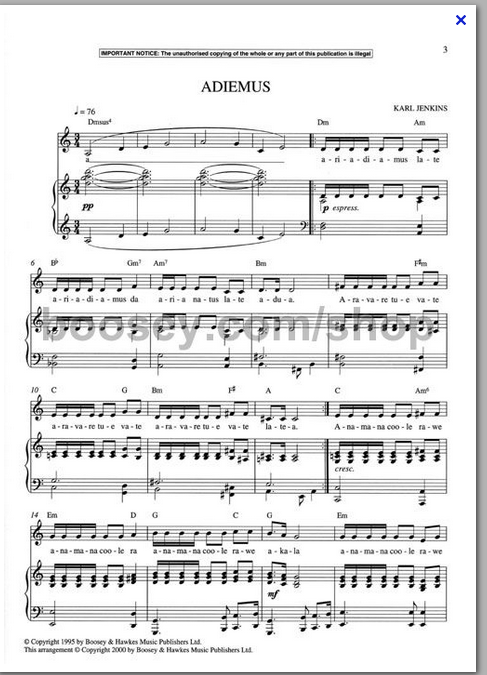
Well, today, she started singing a song that I rather didn’t pay much attention to, not at first anyway. After hearing her for a while, I decided to pay attention. In a matter of seconds I realized what she was singing. Turns out, she was running through the entire song Adiemus (by Karl Jenkins). This song isn’t complicated, but it utilizes melody that ventures along the scale, increasing by half steps and dropping by fifths, octaves, and a whole slew of harmonies and syncopated vocal rounds. She’s picked out the kid’s choir and is singing with them. When she last heard this song, I have no clue.
Anyway, fun stuff. Now I am totally out numbered.
In case one would like a reference point, this is what she’s singing
_________________________
Even in “genuine” AP possessors the skill appears to be somewhat fragile – which fits into the above view. Gerald Moore, the famous English piano accompanist, described in his book “Am I too Loud?” that as a young man he had AP and gradually lost it later. This is most remarkable, as the loss happend in a period of Moore’s life in which he still was fully engaged as an accompanist. He pointed out that he regarded the loss of AP as a relief, i.e., with regard to a problem that he frequently had to solve, namely, transposition of pieces on the piano. In view of the above findings one may be inclined to suspect that Moore may unconsciously have himself “trained off” his AP faculty, as it had made transposition harder to him.
ABSTRACT We used both structural and functional
brain imaging techniques to investigate the neural basis of
absolute pitch (AP), a specialized skill present in some
musicians. By using positron emission tomography, we measured
cerebral blood flow during the presentation of musical
tones to AP possessors and to control musicians without AP.
Listening to musical tones resulted in similar patterns of
increased cerebral blood flow in auditory cortical areas in
both groups, as expected. The AP group also demonstrated
activation of the left posterior dorsolateral frontal cortex, an
area thought to be related to learning conditional associations.
However, a similar pattern of left dorsolateral frontal
activity was also observed in non-AP subjects when they made
relative pitch judgments of intervals, such as minor or major.
Conversely, activity within the right inferior frontal cortex
was observed in control but not in AP subjects during the
interval-judgment task, suggesting that AP possessors need
not access working memory mechanisms in this task. MRI
measures of cortical volume indicated a larger left planum
temporale in the AP group, which correlated with performance
on an pitch-naming task. Our findings suggest that AP
may not be associated with a unique pattern of cerebral
activity but rather may depend on the recruitment of a
specialized network involved in the retrieval and manipulation
of verbal–tonal associations.
The following articles have me learning…
http://gottfriedschlaug.org/musicianbrain/papers/Schlaug_NYAS_2001.pdf
http://www.pnas.org/content/95/6/3172.full.pdf
