This morning on our way to Alamosa, for which Russ was for once present to witness, Lily asked one of her more involved questions. Today it was, “Why do we breathe?”. Suffice it to say, my initial response of “well, surviv…”.
“Yes, I know it’s necessary for our survival.”, a somewhat annoyed 6 year old retorts. “What I want to know is why. Why do we breathe. Why do we breathe oxygen instead of something else? Why breathing?”, as Lily, from the back seat, regards her two parents who begin to try to answer with um, deep breaths.
Eventually, discussion of the elements found common to water and air, the extrapolation of oxygen from the water by sea creatures and such with gills, the amount of oxygen coming from water laden atmosphere, and ultimately, we talked of the connectedness of life, carbon, the idea that life cannot survive without water, the aspect where water has more elements than oxygen alone, that we don’t breathe pure oxygen, and where oxygen comes from (the plant part is too simple, she learned about that with Russ’s illness this year, she thinks there’s more too it). Take a breath… But then she asked again, “Why?”.
Alas, Russ and I responded how much we appreciated her sharing such questions and thoughts with us… and told her, as we have had to so many times already in her short life, “Well, thankfully we have the internet, because we don’t know how to answer that yet, but we will (both know) soon.”

We were talking tonight about the elements of water, and she decided to mention the following experiment, as something she wanted to do.
At first, she stated that she recalled that the sheet of paper could be removed, and that the pressure in the air would keep the water from spilling out of the jar. I indicated that I was skeptical of her recollection and expectation, so I looked up the experiment. And while no, one cannot exactly remove the paper if water is expected to remain in the jar, there is a component of atmospheric pressure at play here, for which she clearly has been informed of (or perhaps concluded on her own) previously. Read on, you’ll see.


Defying the laws of gravity? Drinking water upside down? This must be magic… or science!
What you Need
- A glass
- Water
- A note card
- A sink

What to Do
- Fill your glass of water to the top.

- Place the note card over the top of the glass.

- Quickly turn the glass upside down over the sink (just in case the experiment goes wrong), holding the note card in place and then, carefully let go of the note card.

What’s Going On?
There are a couple of concepts at work in this experiment. The first has to deal with pressure and the second has to do with surface tension.
Diagram showing the positive hydrogen ends of the water molecule being attracted to the negative oxygen ends of the water molecule. Attraction represented by the dotted line.
There are a couple places where pressure is pushing against the card. First the atmospheric pressure or the tiny air molecules all around us are randomly colliding with the bottom of the note card. This pressure holds the card up, but why doesn’t the weight of the water push the note card down? Isn’t the weight of the water enough to overcome the atmospheric pressure pushing against the card? That’s what most people would think, but if you look at the top of the glass of water (formerly the bottom), you’ll notice a small pocket of air. Actually there isn’t much of an opportunity for air to get into that space, so what we’ve created is a small pocket of low pressure (a place where there really isn’t that many air molecules). There are more air molecules pushing up against the bottom of the note card, creating a higher pressure area compared with the lower pressure area inside the air pocket in the glass. The force from the atmospheric pressure holds the card up and the low pressure zone in the glass prevents the water’s weight from pushing the card down.
This is a great explanation of why this works, but there is more. The second concept in this experiment is surface tension and adhesion. Surface tension is created by how the water molecules orient themselves. Because the Oxygen atom steals electrons from the hydrogen atoms in a water molecule, water molecules become a dipole, in this case a molecule that has a positive end and a negative end. If you think about each water molecule like it is a tiny magnet, where like charges repel each other and unlike charges attract, you’ll see that there is a small attractive force between each water molecule. This force is responsible for surface tension, where the water molecule stick together through this attractive force, creating an elastic-like surface layer.
Adhesion occurs because water molecules, having the positive and negative ends, are also attracted to other materials. In the experiment that you conducted, the water molecules are attracted to the paper, adhering to it, while continuing to keep the surface tension with the other water molecules. This keeps the note card in place.
In summary, the note card doesn’t fall down because of the difference in pressure and it doesn’t slide off because of surface tension and adhesion. So, it might look like magic, but it’s really science.
Try This!
- Try putting soap around the rim of the glass and repeating this experiment. Make sure you do this over the sink. What happens?
- Try putting a small piece of mesh screen (like from a screen door) between the note card and the glass. What happens?
  |
|||
For future learning, http://highered.mcgraw-hill.com/sites/dl/free/0073048763/232418/chapter01.pdf
Individually and collectively, we take the air we breathe for granted. Yet our atmosphere
is a fragile, thin veil of essential gases interspersed with pollutants in differing amounts.
It surrounds the third planet from the Sun, helping to make habitable the place we call
home.
The “blue marble,” our Earth, as seen from outer space.
“The fi rst day or so, we all pointed to our countries. The third or fourth day, we were pointing
to our continents. By the fi fth day, we were aware of only one Earth.”
Prince Sultan Bin Salmon Al-Saud, Saudi Arabian astronaut
| |
 Basic Information | Atomic Structure | Isotopes | Related Links | Citing This Page Basic Information
Atomic Structure
Isotopes
Facts
|
![[Bohr Model of Oxygen]](http://www.chemicalelements.com/bohr/b0008.gif)
Oxygen was first discovered by Swedish pharmacist Carl Wilhelm Scheele. He had produced oxygen gas by heating mercuric oxide and various nitrates by about 1772.[5][59] Scheele called the gas “fire air” because it was the only known supporter of combustion, and wrote an account of this discovery in a manuscript he titled Treatise on Air and Fire, which he sent to his publisher in 1775. However, that document was not published until 1777.[63]

Joseph Priestley is usually given priority in the discovery.
In the meantime, on August 1, 1774, an experiment conducted by the British clergyman Joseph Priestley focused sunlight onmercuric oxide (HgO) inside a glass tube, which liberated a gas he named “dephlogisticated air”.[5] He noted that candles burned brighter in the gas and that a mouse was more active and lived longer while breathing it. After breathing the gas himself, he wrote: “The feeling of it to my lungs was not sensibly different from that of common air, but I fancied that my breast felt peculiarly light and easy for some time afterwards.”[25] Priestley published his findings in 1775 in a paper titled “An Account of Further Discoveries in Air” which was included in the second volume of his book titled Experiments and Observations on Different Kinds of Air.[59][64] Because he published his findings first, Priestley is usually given priority in the discovery.
In 1774, Joseph Priestley discovered that oxygen was released by heating mercuric oxide, although he did not identify the gas as Oxygen (rather, Priestley called it “dephlogisticated air”, as that was the paradigm that he was working under at the time.)[3]
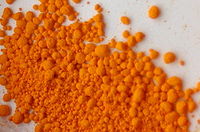
Mercury(II) oxide, also called mercuric oxide or simply mercury oxide, has a formula of HgO. It has a red or orange color. Mercury(II) oxide is a solid at room temperature and pressure. The mineral form montroydite is very rarely found.
The noted French chemist Antoine Laurent Lavoisier later claimed to have discovered the new substance independently. However, Priestley visited Lavoisier in October 1774 and told him about his experiment and how he liberated the new gas. Scheele also posted a letter to Lavoisier on September 30, 1774 that described his own discovery of the previously unknown substance, but Lavoisier never acknowledged receiving it (a copy of the letter was found in Scheele’s belongings after his death).[63]

Lavoisier’s contribution
What Lavoisier did indisputably do (although this was disputed at the time) was to conduct the first adequate quantitative experiments on oxidation and give the first correct explanation of how combustion works.[5] He used these and similar experiments, all started in 1774, to discredit the phlogiston theory and to prove that the substance discovered by Priestley and Scheele was a chemical element.
Chemical element
.svg) |
|
| Top: the periodic table of the chemical elements. |
A chemical element is a pure chemical substance consisting of a single type of atom distinguished by its atomic number, which is the number of protons in its atomic nucleus. Elements are divided into metals, metalloids, and non-metals. Familiar examples of elements are carbon, oxygen (non-metals), silicon, arsenic (metalloids), aluminium, iron, copper, gold, mercury, and lead (metals).
The lightest chemical elements, including hydrogen, helium and smaller amounts of lithium, beryllium and boron, are thought to have been produced by various cosmic processes during the Big Bang and cosmic-ray spallation. Production of heavier elements, from carbon to the very heaviest elements, proceeded by stellar nucleosynthesis, and these were made available for later solar system and planetary formation by planetary nebulae and supernovae, which blast these elements into space.[1] The high abundance of oxygen, silicon, and iron on Earth reflects their common production in such stars. While most elements are generally stable, a small amount of natural transformation of one element to another also occurs in the decay of radioactive elements as well as other natural nuclear processes[clarification needed].
Question: Where did the elements that came from the stars gone supernovae, etc., originate from?