Kala is taking a class that explores the theory behind the game, looks at different interpretations and iterations, and encourages the group to create their own variations to expand the simple game.
Session one of four discussed:
The group explored:
We were asked to review the following over this week, in preparation for the next meeting.
Tic Tac Toe and Beyond Puzzles and
Musings 1
First a reminder: These puzzles are intended to get you to think and play, not to have easy answers. You may feel stuck. You may need help getting started. It’s
okay to ask for help. Just post in our classroom or contact me directly. Posting
in the classroom is a great way to get everyone involved in solving these puzzles.
Then, you need a link. Really. Here it is: https://xkcd.com/832/ – A complete
strategy guide to tic tac toe, XKCD style.
1. We discussed that there are three opening moves to the traditional tic
tac toe game. How many second moves on there, using the same kind
of thinking about identical moves? (Okay, this one is too easy after all
the analysis you did. How many THIRD moves are there? Or pose a
question yourself…)
2. The question of how many distinct games are there is challenging.
Let’s ask a simpler question. How many ways can you fill the board
with 5 X’s and 4 O’s?
3. Okay, now, how can we use that to think about the number of distinct
games? What are the issues with using that to help us think about it?
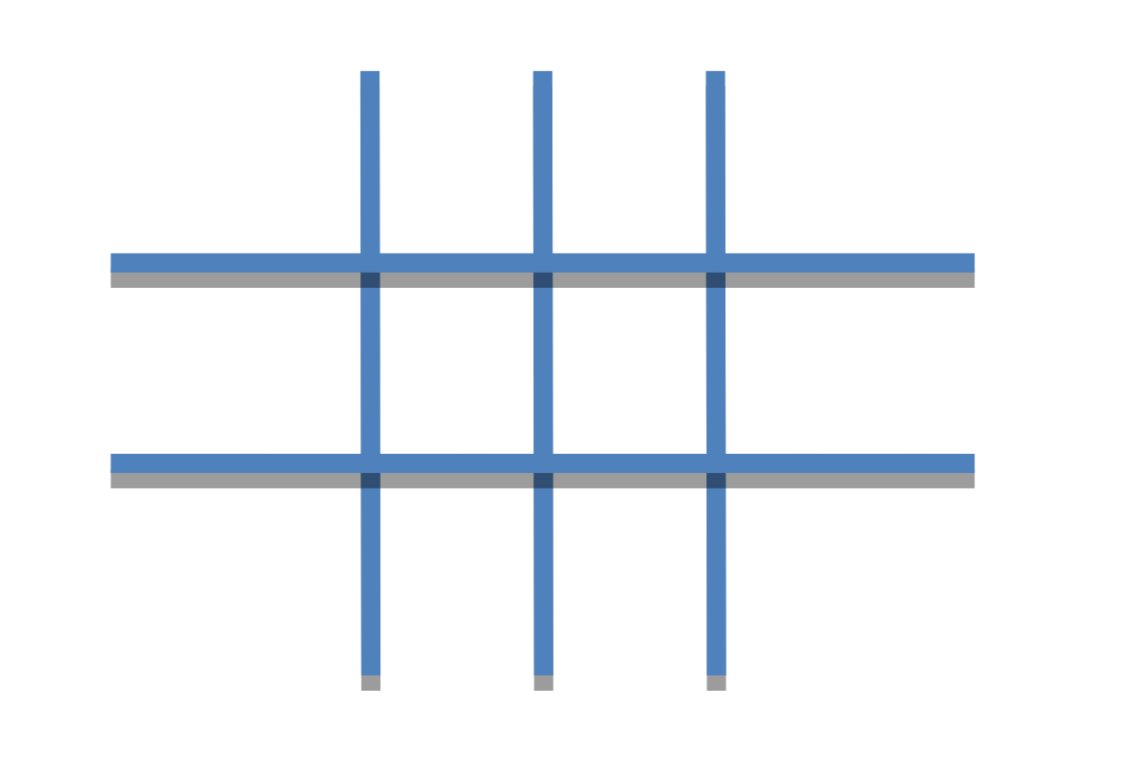
4. Our first variation was a grid with an additional vertical line, as below.
What if we change the win condition to be four in a row if horizontal,
three in a row if vertical or diagonal?
How does that change the
strategy?
5. How else might you play with the board above?
6. Our second variation considered changing the win condition. What
other ways could we change the win condition? (You got a start on this
as well. Think of more ideas.)
7. Choose one of the ways you suggested in #5 and analyze the strategies
based on that win condition.
Description
Tic Tac Toe, Naughts and Crosses, whatever you have learned to call it... it needs some improvement to make it worth playing.
In the Mathematics of Games series, we’ll explore different games (typically tabletop) and the mathematics that drives them, analyzing probabilities, discussing how to maximize a strategy, and consider the implications of variations on the game.  Students will play the games (as much as possible in the class), explore the mathematics, and create and evaluate their own variations.
If you're like me, you find the basic game of Tic Tac Toe pretty boring.  You may even know how to always force at least a tie, or what the best first moves are to make it most likely that you'll win - if your opponent isn't savvy.  In this class, we'll look at the topology of the game and analyze strategies using a game theory approach - where our strategy is based on likely responses, not just what we hope will happen.  We'll involve probability and combinatorics to analyze the number of possible games.  But that's just the basic game...
Then, we start changing the rules.  We'll explore different win conditions, different boards, different rules of play.   We'll try 3-D tic tac toe, Quantum tic tac toe, Go Mo Ku, and more.  We will then innovate by exploring student proposed variations, looking at the mathematics and strategy behind each, and drawing conclusions about the "best" way to modify the game.
Students should know how to play Tic Tac Toe before taking this class.  However, the basic game is very simple - students who have never seen it will likely pick it up very quickly.  Homework will involve playing variations of the game, evaluating strategy in the variations, and other puzzles.