PBS Documentary, Mozart’s life
Wolfgang Amadeus Mozart and his father, Leopold Mozart, both played and composed music. As well as his older sister, Maria Anna Mozart. Mozart lived in the Classical Period. He was born in 1756 and died 1791. His full name was Johannes Chrysostomus Wolfgangus Theophilus Mozart.
Mozart had six children, only two of whom survived. Their names were Karl Thomas Mozart and Franz Xavier Wolfgang Mozart. Karl was a pianist, Xavier was a musician. Mozart has no living descendants.
What do you think about the reactions of his composing at age 5?
Mozart died young, seems tragic. He was not wealthy and I had the impression that he likely had plenty of money.
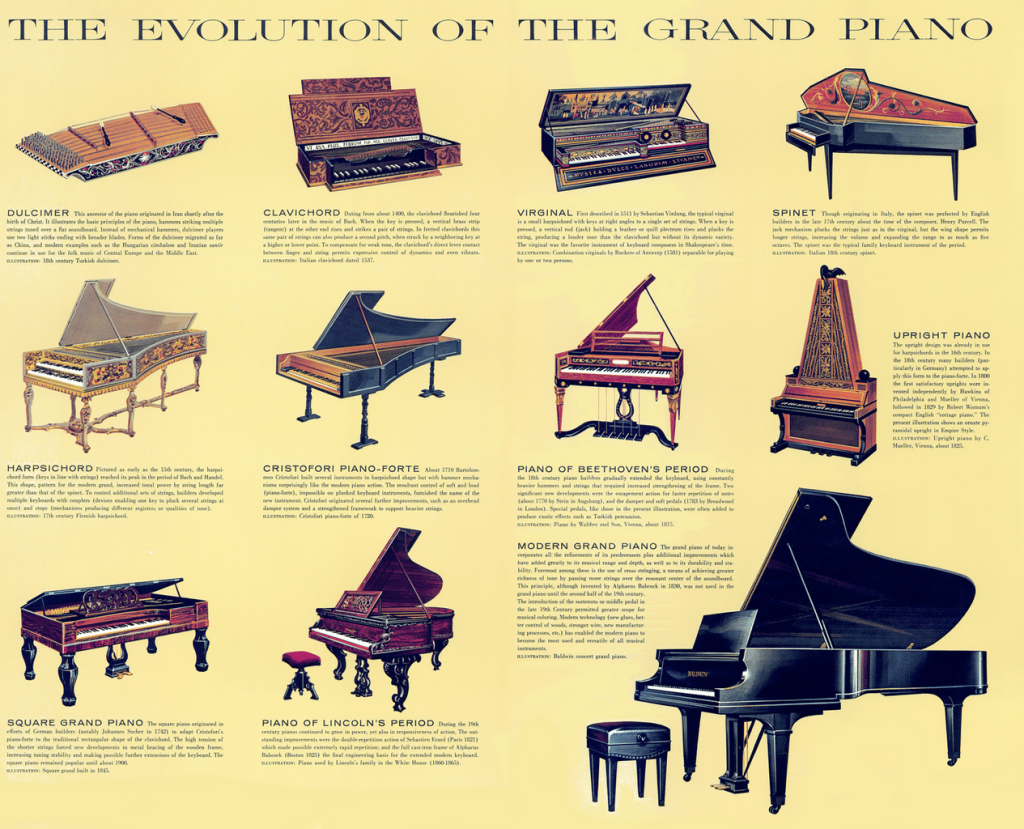
The History of the Piano
The Classical era arose from a reaction against many of the established musical norms and composers worked on developing a very different sound.
It is in the Classical period that the idea of the Equal Temperament scale finally becomes accepted and tonality, as we recognise it even today, becomes permanently established.
It is in the Classical period that the idea of the Equal Temperament scale finally becomes accepted and tonality, as we recognise it even today, becomes permanently established.
In the Classical period is the height of the tonal system with a clear polarity of tonic and dominant harmony. Tonic refers to the starting or home key of the piece and the word dominant refers to the next most harmonically important key, that of the 5th; based on the 5th note of the scale.
The power of the tonal system and the pull of the tonic dominant relationship gave structure to larger forms than just composition of melody during the Classical period. It allowed composers to develop a hugely innovative musical form called “sonata form”. This structure provided the building blocks for concertos, symphonies and sonatas.
The principle of the form is simple. In its purest form there are three sections that make up the entire form. These are the exposition, the development and the recapitulation. In the first section (exposition), the composer would usually present two contrasting themes; one based in the tonic, the other in the dominant. In the development section, the composer explores the melodic, rhythmic, textural and harmonic possibilities of each theme. In the final part of the form (recapitulation), we hear the same themes restated and sometimes reworked.
What sonata form offered composers in the Classical period was the harmonic elegance of a tonic dominant system and the chance to fully explore the material of their compositions rather than simply a statement of melody. If you are listening to the first movement of a symphony, a concerto or a sonata from the classical period, the chances are it is written in sonata form.
The Piano began to occupy a central place in the line-up of available instruments for the Classical composers to explore. It left behind the jangly unreliability of the harpsichord and as it developed it matured into an instrument of great range and expressive possibilities. Piano sonatas and concertos make up a large portion of the Classical repertoire.
a list of a few really key Classical pieces that everyone interested in this period of music is encouraged to listen to and explore. In many of these landmark works, you can hear the characteristics that held this great time in musical history together.
Haydn:
String Trio No. 26 in G major: Hob.V:G4
String Quartets Op.76; nos. 1-4
Piano Sonata in C minor: Hob. XVI/20
The “London” Symphonies Nos. 93-98
“The Creation” Oratorio – Hob.XXI/2
Mozart:
Symphony No.40 in G minor; K.550
Piano Concerto in A major; K.488
Piano Sonata in A minor; K.300
String Quartet No.17, “The Hunt”; K.458