Yesterday, Lily inquired, as we were on our way to our Alamosa group for play and discovery, about the atmosphere and global economics.
She indicated she understood the concept of the water cycle, mostly. Though I think she is skeptical at just how cyclical the whole thing is, but mostly, she questions where the water came from in the first place. Yes, yes, she has heard about water filled asteroids and the idea of no oceans – then oceans forming, but much like our current scientific theory, she’s not convinced.
So, upon my effort to describe the content of our present atmosphere, and how it regenerates itself, I found myself without words. It appeared as though she already knew the makeup of the atmosphere, and the general idea of how it was/does form/remain, but she thinks there’s more to the story. I did a sharp 90 in my attempts to explain, or at least address some of what I thought might be useful for her to contemplate, and just as I was jogging along my new route, she blurts out, “Do all American humans think they’re better than everybody else on the planet?”.
“Uh, no, I don’t think so….”, knowing full well the atmosphere question would resume later in the day and in subsequent days, I simply fell silent, waiting for what I thought I knew was coming, “I don’t think we’re better than everybody else”.
“Ok, but you don’t count, you’re not human. ANYway, why do we have enough food and a big house and parks and stuff while other people live in piles of dirt, don’t have cars, and fight about having enough food?” As I was opening my mouth, completely without anything profound to actually say…. “I mean, what exactly is it that makes some people on our planet just fine and others struggle so much?”
Add world economics and societal studies to the list of subjects we are apparently going to delve into.
Then, as a night cap, the three of us stayed up late watching an episode of Cosmos that just so happened to not only address things like the changing earth’s shape and land mass modifications, but also addressed the atmosphere’s of present and past, as well as a few other relevant topics. She seemed to really find the show interesting, with lots of commentary and questions, and lots of interaction and pausing for discussion, some of which was my initiation, some hers. Where typically, Lils is bouncing and climbing and all over the place during most shows (adult/kid/otherwise), much like the Hawking documentary, Stirling concerts, baking shows with Roe, and Bill Nye (along with a slew of animated films), she sat between Russ and I for the entire thing (without our request). – I wonder if some of her interest wasn’t more associated with Russ’s interest than the content, but maybe both were equal influences.
Where does water come from?
Shortly after the big bang, protons, neutrons and electrons swarmed in 10 billion degree heat [source: NASA]. Within minutes, hydrogen and then helium, known as the lighter elements, had taken shape from these atomic building blocks in a process callednucleosynthesis. (Lithium had a cameo as well.) The heavier elements didn’t appear until much later, when the lighter elements underwent fusion inside of stars and during supernovas. Over time, stars sent wave after wave of these heavier elements, including oxygen, out into space where they mixed with the lighter elements. Of course, the formation of hydrogen and oxygen molecules and the subsequent formation of water are two different things. That’s because even when hydrogen and oxygen molecules mix, they still need a spark of energy to form water. The process is a violent one, and so far nobody has found a way to safely create water on Earth.
So how did our planet come to be covered with oceans, lakes and rivers? The simple answer is we still don’t know, but we have theories. One theory states that, nearly 4 billion years ago, millions of asteroids andcomets slammed into the Earth’s surface; a quick glance at the moon’s crater-pocked surface gives us an idea of what conditions were like. The theory goes that these weren’t normal rocks but rather the equivalent of cosmic sponges, loaded with water that was released on impact.
While astronomers have confirmed that some asteroids and comets hold water, some scientists think the theory doesn’t. For one thing, scientists still haven’t found any remnants of the comets and asteroids. What’s more, they question whether enough collisions could have taken place to account for all of the water in Earth’s oceans. Finally, researchers from the California Institute of Technology found that water from the comet Hale-Bopp contains much more heavy water (which has more deuterium) than Earth’s oceans, meaning either the comets and asteroids that hit Earth were very different than Hale-Bopp, or Earth got its water some other way.
Another recent theory states that a young Earth was bombarded by oxygen and other heavy elements produced within the sun. The oxygen combined with hydrogen and other gases released from the Earth in a process known as degassing, forming the Earth’s oceans and atmosphere along the way. A team of scientists from Japan’s Tokyo Institute of Technology has devised yet another theory, which states that a thick layer of hydrogen may have once covered the Earth’s surface, eventually interacting with oxides in the crust to form our planet’s oceans.
And so, while we can’t say with certainty how water came to Earth, we can say we’re fortunate it did.
Sources
- Environmental Graffiti. “Mother Earth: Water: The Lifeblood of our Planet.” (7/30/2010)http://www.environmentalgraffiti.com/ecology/mother-Earth-water-the-lifeblood-of-our-planet/586
- European Space Agency. “When did liquid water fill the planets?” Jan. 17, 2002. (7/30/2010)http://sci.esa.int/science-e/www/object/index.cfm?fobjectid=29255
- Lenz, George. “H2O – The Mystery, Art, and Science of Water: The Physics of Water on Earth.” Sweet Briar College. (7/30/2010)http://witcombe.sbc.edu/water/physicsEarth.html
- Muir, Hazel. “Earth’s water brewed at home, not in space.” NewScientist. Sept. 25, 2007. (7/30/2010)http://www.newscientist.com/article/dn12693
- NASA. “Earth’s Water Probably Didn’t Come From Comets.” (7/30/2010)http://www2.jpl.nasa.gov/comet/news98.html
- NASA. “Tests of the Big Bang: The Light Elements.” (7/30/2010)http://map.gsfc.nasa.gov/universe/bb_tests_ele.html
- NASA. “When and how did the elements of life in the Universe arise?” (7/30/2010)http://science.nasa.gov/astrophysics/big-questions/when-and-how-did-the-elements-of-life-in-the-universe-arise/
- SpaceDaily. “When Did Liquid Water Fill The Planets.” Jan. 21, 2002. (7/30/2010)http://www.spacedaily.com/news/early-Earth-02b.html


How did Earth’s atmosphere form?
So how did our atmosphere get to be so special? Some scientists describe three stages in the evolution of Earth’s atmosphere as it is today.
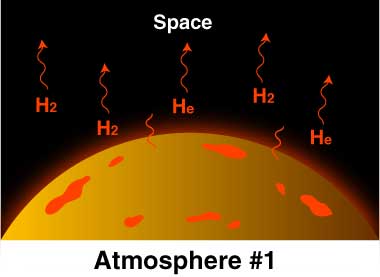
Just formed Earth: Like Earth, the hydrogen (H2) and helium (He) were very warm. These molecules of gas moved so fast they escaped Earth’s gravity and eventually all drifted off into space.
- Earth’s original atmosphere was probably just hydrogen and helium, because these were the main gases in the dusty, gassy disk around the Sun from which the planets formed. The Earth and its atmosphere were very hot. Molecules of hydrogen and helium move really fast, especially when warm. Actually, they moved so fast they eventually all escaped Earth’s gravity and drifted off into space.
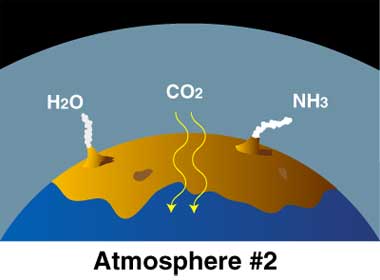
Young Earth: Volcanoes released gases H2O (water) as steam, carbon dixoide (CO2), and ammonia (NH3). Carbon dioxide dissolved in seawater. Simple bacteria thrived on sunlight and CO2. By-product is oxygen (O2).
- Earth’s “second atmosphere” came from Earth itself. There were lots of volcanoes, many more than today, because Earth’s crust was still forming. The volcanoes released
- steam (H2O, with two hydrogen atoms and one oxygen atom),
- carbon dioxide (CO2, with one carbon atoms and two oxygen atoms),
- ammonia (NH3, with one nitrogen atom and three hydrogen atoms).
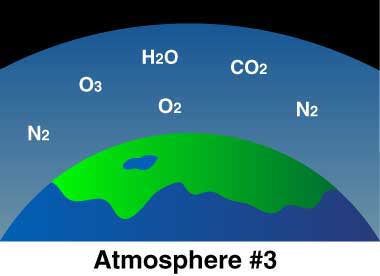
Current Earth: Plants and animals thrive in balance. Plants take in carbon dioxide (CO2) and give off oxygen (O2). Animals take in oxygen (O2) and give off CO2. Burning stuff also gives off CO2.
- Much of the CO2 dissolved into the oceans. Eventually, a simple form of bacteria developed that could live on energy from the Sun and carbon dioxide in the water, producing oxygen as a waste product. Thus, oxygen began to build up in the atmosphere, while the carbon dioxide levels continued to drop. Meanwhile, the ammonia molecules in the atmosphere were broken apart by sunlight, leaving nitrogen and hydrogen. The hydrogen, being the lightest element, rose to the top of the atmosphere and much of it eventually drifted off into space.
Now we have Earth’s “third atmosphere,” the one we all know and love—an atmosphere containing enough oxygen for animals, including ourselves, to evolve. So plants and some bacteria use carbon dioxide and give off oxygen, and animals use oxygen and give off carbon-dioxide—how convenient! The atmosphere upon which life depends was created by life itself.
