Electrons, particles, positive and negative charge…
“My phone’s display is made by a whole bunch of little lights, isn’t it?”
We discussed the difference between lights made through heat, friction, expansion, and chemical reaction. We talked about fluorescent lights, how the plasma ball lights and how it can turn on a fluorescent bulb, and colored LEDs.
Today was challenging emotionally. I think Lily is embarking on a new phase of growth.
How LCDs Work

by Jeff Tyson (edited for relevance for Lily)
Creating an LCD
There’s more to building an LCD than simply creating a sheet of liquid crystals. The combination of four facts makes LCDs possible:
- Light can be polarized. (See How Sunglasses Work for some fascinating information on polarization!)
- Liquid crystals can transmit and change polarized light.
- The structure of liquid crystals can be changed by electric current.
- There are transparent substances that can conductelectricity.
An LCD is a device that uses these four facts in a surprising way.
To create an LCD, you take two pieces of polarized glass. A special polymer that creates microscopic grooves in the surface is rubbed on the side of the glass that does not have the polarizing film on it. The grooves must be in the same direction as the polarizing film. You then add a coating of nematic liquid crystals to one of the filters. The grooves will cause the first layer of molecules to align with the filter’s orientation. Then add the second piece of glass with the polarizing film at a right angle to the first piece. Each successive layer of TN molecules will gradually twist until the uppermost layer is at a 90-degree angle to the bottom, matching the polarized glass filters.
As light strikes the first filter, it is polarized. The molecules in each layer then guide the light they receive to the next layer. As the light passes through the liquid crystal layers, the molecules also change the light’s plane of vibration to match their own angle. When the light reaches the far side of the liquid crystal substance, it vibrates at the same angle as the final layer of molecules. If the final layer is matched up with the second polarized glass filter, then the light will pass through.
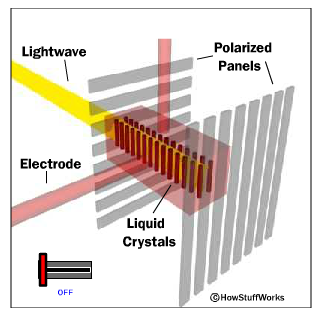
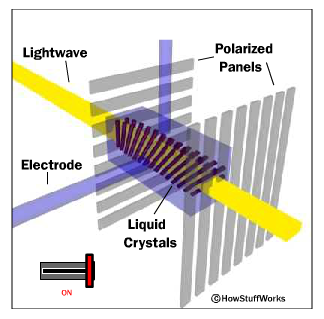
Building a simple LCD is easier than you think. Your start with the sandwich of glass and liquid crystals described above and add two transparent electrodes to it. For example, imagine that you want to create the simplest possible LCD with just a single rectangular electrode on it. The layers would look like this:
The LCD needed to do this job is very basic. It has a mirror (A) in back, which makes it reflective. Then, we add a piece of glass (B) with a polarizing film on the bottom side, and a common electrode plane (C) made of indium-tin oxide on top. A common electrode plane covers the entire area of the LCD. Above that is the layer of liquid crystal substance (D). Next comes another piece of glass (E) with an electrode in the shape of the rectangle on the bottom and, on top, another polarizing film (F), at a right angle to the first one.
The electrode is hooked up to a power source like a battery. When there is no current, light entering through the front of the LCD will simply hit the mirror and bounce right back out. But when the battery supplies current to the electrodes, the liquid crystals between the common-plane electrode and the electrode shaped like a rectangle untwist and block the light in that region from passing through. That makes the LCD show the rectangle as a black area.
You probably use items containing an LCD (liquid crystal display) every day. They are all around us — in laptop computers, digital clocks and watches, microwave ovens, CD players and many other electronic devices. LCDs are common because they offer some real advantages over other display technologies. They are thinner and lighter and draw much less power than cathode ray tubes (CRTs), for example.
But just what are these things called liquid crystals? The name “liquid crystal” sounds like a contradiction. We think of a crystal as a solid material like quartz, usually as hard as rock, and a liquid is obviously different. How could any material combine the two?
Solids act the way they do because their molecules always maintain their orientation and stay in the same position with respect to one another. The molecules in liquids are just the opposite: They can change their orientation and move anywhere in the liquid. But there are some substances that can exist in an odd state that is sort of like a liquid and sort of like a solid. When they are in this state, their molecules tend to maintain their orientation, like the molecules in a solid, but also move around to different positions, like the molecules in a liquid. This means that liquid crystals are neither a solid nor a liquid. That’s how they ended up with their seemingly contradictory name.
So, do liquid crystals act like solids or liquids or something else? It turns out that liquid crystals are closer to a liquid state than a solid. It takes a fair amount of heat to change a suitable substance from a solid into a liquid crystal, and it only takes a little more heat to turn that same liquid crystal into a real liquid. This explains why liquid crystals are very sensitive to temperature and why they are used to makethermometers and mood rings. It also explains why a laptop computer display may act funny in cold weather or during a hot day at the beach.

Most liquid crystal molecules are rod-shaped and are broadly categorized as either thermotropic or lyotropic.
Image courtesy Dr. Oleg Lavrentovich, Liquid Crystal Institute
Nematic Phase Liquid Crystals
Just as there are many varieties of solids and liquids, there is also a variety of liquid crystal substances. Depending on the temperature and particular nature of a substance, liquid crystals can be in one of several distinct phases (see below). In this article, we will discuss liquid crystals in the nematic phase, the liquid crystals that make LCDs possible.
One feature of liquid crystals is that they’re affected by electric current. A particular sort of nematic liquid crystal, called twisted nematics (TN), is naturally twisted. Applying an electric current to these liquid crystals will untwist them to varying degrees, depending on the current’s voltage. LCDs use these liquid crystals because they react predictably to electric current in such a way as to control light passage.
Most liquid crystal molecules are rod-shaped and are broadly categorized as either thermotropic orlyotropic.
Thermotropic liquid crystals will react to changes in temperature or, in some cases, pressure. The reaction of lyotropic liquid crystals, which are used in the manufacture of soaps and detergents, depends on the type of solvent they are mixed with. Thermotropic liquid crystals are either isotropic or nematic. The key difference is that the molecules in isotropic liquid crystal substances are random in their arrangement, while nematics have a definite order or pattern.
The orientation of the molecules in the nematic phase is based on the director. The director can be anything from a magnetic field to a surface that has microscopic grooves in it. In the nematic phase, liquid crystals can be further classified by the way molecules orient themselves in respect to one another.Smectic, the most common arrangement, creates layers of molecules. There are many variations of the smectic phase, such as smectic C, in which the molecules in each layer tilt at an angle from the previous layer. Another common phase is cholesteric, also known as chiral nematic. In this phase, the molecules twist slightly from one layer to the next, resulting in a spiral formation.
Ferroelectric liquid crystals (FLCs) use liquid crystal substances that have chiral molecules in a smectic C type of arrangement because the spiral nature of these molecules allows the microsecond switching response time that make FLCs particularly suited to advanced displays. Surface-stabilized ferroelectric liquid crystals (SSFLCs) apply controlled pressure through the use of a glass plate, suppressing the spiral of the molecules to make the switching even more rapid.

Color LCD
An LCD that can show colors must have three subpixels with red, green and blue color filters to create each color pixel.
Through the careful control and variation of the voltage applied, the intensity of each subpixel can range over 256 shades. Combining the subpixels produces a possible palette of 16.8 million colors (256 shades of red x 256 shades of green x 256 shades of blue), as shown below. These color displays take an enormous number of transistors. For example, a typical laptop computer supports resolutions up to 1,024×768. If we multiply 1,024 columns by 768 rows by 3 subpixels, we get 2,359,296 transistors etched onto the glass! If there is a problem with any of these transistors, it creates a “bad pixel” on the display. Most active matrix displays have a few bad pixels scattered across the screen.

LCD technology is constantly evolving. LCDs today employ several variations of liquid crystal technology, including super twisted nematics (STN), dual scan twisted nematics (DSTN), ferroelectric liquid crystal (FLC) and surface stabilized ferroelectric liquid crystal (SSFLC).
Display size is limited by the quality-control problems faced by manufacturers. Simply put, to increase display size, manufacturers must add more pixels and transistors. As they increase the number of pixels and transistors, they also increase the chance of including a bad transistor in a display. Manufacturers of existing large LCDs often reject about 40 percent of the panels that come off the assembly line. The level of rejection directly affects LCD price since the sales of the good LCDs must cover the cost of manufacturing both the good and bad ones. Only advances in manufacturing can lead to affordable displays in bigger sizes.
http://inventors.about.com/od/lstartinventions/a/LCD.htm