Yesterday we were working on our Winter Spiral and while I was finishing up the dailies,
looking for ideas on pinterest, a mention of a book came across the screen.
So, we looked it up on Amazon and ran through some of the shared/look pages to see what it was all about.
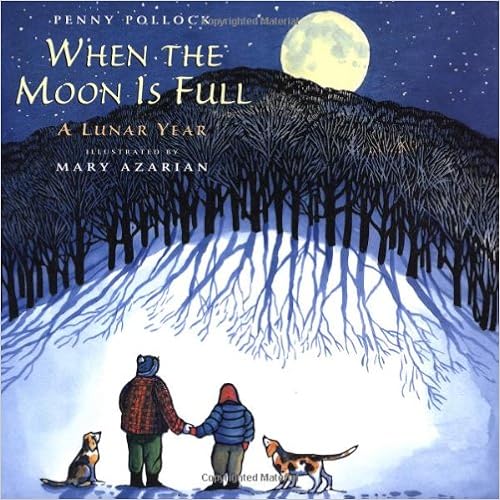
I’ll share a few shots of the book below. Lily was busy building something for the turtle as I began to read about the various moons, their names, beliefs from various cultures about the moon’s phases, etc… She listened and interacted more than I expected, including howling (wolf moon).

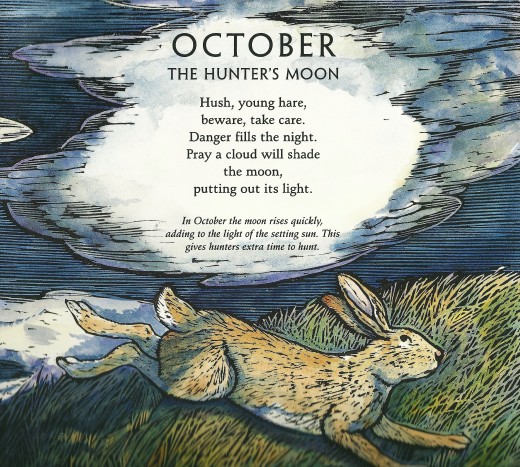
Then, we read the following and talked about the various points, which lead to a quick research project of my own related to the moon’s gender. We talked of women and their cycles, and how there is a connection with the moon because of light and ovulation, not necessarily cycle duration.
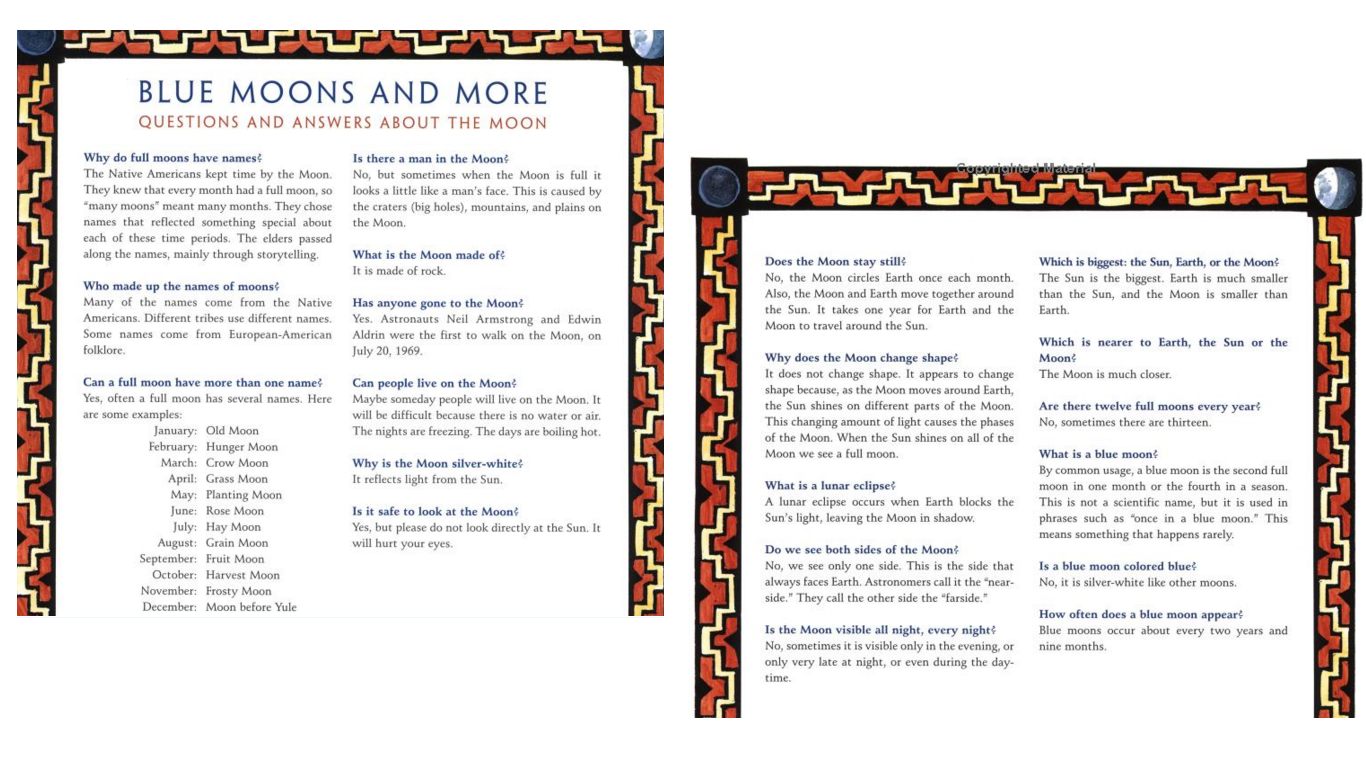
We talked about the lunar eclipse, which she struggled a little bit to explain accurately, but the two questions above this one on the book page shown above is what really led to the rest of the exploration. I asked her whether she thought the moon stood still and she said no, and so I asked her whether we regularly see all sides of the moon, to which she initially said yes, then, well, she wasn’t certain. She did clearly express the makeup of the moon, discussed craters and reflective quality of the rock, but then when we got to the question about whether the moon stays still, she had some theories.
We looked up whether or not the moon spins (rotates) like the earth does, learned that indeed it does, but as a result of the earth’s gravitational pull on the moon, it rotates at the same speed as its orbit, which keeps the same side always showing to the earth.
Attentive observers on Earth might notice that the moon essentially keeps the same side facing our planet as it passes through its orbit. This may lead to the question, does the moon rotate? The answer is yes, though it may seem contrary to what our eyes observe.
The ‘dark’ side of the moon
The moon orbits the Earth once every 27.322 days. It also takes approximately 27 days for the moonto rotate once on its axis. As a result, the moon does not seem to be spinning but appears to observers from Earth to be keeping almost perfectly still. Scientists call this sychronous rotation.
By using the Wide Angle Camera (WAC) aboard NASA’s Lunar Reconnaissance Orbiter (and adjusting brightness), this unique view of the moon has been created.
The orbit and the rotation aren’t perfectly matched, however. The moon travels around the Earth in an elliptical orbit, a slightly stretched-out circle. When the moon is closest to Earth, its rotation is slower than its journey through space, allowing observers to see an additional 8 degrees on the eastern side. When the moon is farthest, the rotation is faster, so an additional 8 degrees are visible on the western side. [The Moon: 10 Surprising Lunar Facts]
While the near side of the moon is smoothed by maria — large dark plains created by solidified lava flows — and light lunar highlands, the far side is heavily cratered.
[VIDEO: A Year of Lunar Phases and Wobbles]
>>> Then, we moved onto the question of whether the moon changes shape, which led to a whole mindstorm of exploration, that eventually culminated in learning about tidal forces, tidal friction, bulges, and wondering what its like on worlds without water based oceans that have moons effecting them.
One of the pages we visited posed a question, “I noticed that out moon doesn’t rotate as it orbits our earth. Is our moon the only moon in our solar system that doesn’t rotate?”
The answer is as follows:
The Moon does rotate. If you stood on the Moon, the stars would rise and set, just like they do on Earth, except that a lunar day is a month long, the same as the Moon’s orbital period. The Moon rotates at just the right speed so that it always keeps one face pointed toward the Earth, which seems like a pretty big coincidence, doesn’t it?
Your question is very interesting because the answer is that, no, the Moon is not unique. Almost all moons in the Solar System keep one face pointed toward their planet. (The only exception we know of is Hyperion, a moon of Saturn.) This tells us it’s probably not a coincidence, that there is probably a reason for this to happen, a physical process that happens to most moons to slow their rotation.
That process is called tidal friction. You probably know that the Moon’s gravity affects the Earth’s oceans. Well, the Earth’s gravity also affects the Moon. It distorts the Moon’s shape slightly, squashing it out so that it is elongated along a line that points toward the Earth. We say that the Earth raises “tidal bulges” on the Moon.
The Earth’s gravity pulls on the closest tidal bulge, trying to keep it aligned with Earth. As the Moon turns, feeling the Earth’s gravity, this creates friction within the Moon, slowing the Moon’s rotation down until its rotation matches its orbital period exactly, a state we call tidal synchronization. In this state, the Moon’s tidal bulge is always aligned with Earth, which means that the Moon always keeps one face toward Earth.
Other planets raise tides on their moons, too, so almost all the moons in the Solar System are tidally synchronized. There’s even one planet that is sychronized to its moon! Charon, Pluto’s moon, is so large and so close to Pluto that the planet and moon are both locked into the same rotational rate. The Moon slows the Earth’s rotation, too, but at a very slow rate, increasing the length of the day by a couple of milliseconds each century.
You might be wondering what’s up with Hyperion. Gravitational interaction with other moons of Saturn cause Hyperion to tumble chaotically, so Saturn doesn’t even get a chance at tidal synchronization before Hyperion’s rotational state is changed by another moon. There may be other small moons that behave in this manner, as well, but it is difficult to measure the rotational periods of small moons around distant planets, so we don’t know of any yet.
This page was last updated on July 18, 2015.
At this point, Lily and I were both hooked. I wanted to know about tidal friction/forces, and she started plotting how she was going to employ Gru to simply reshape the moon this time, instead of steal it out of the sky.
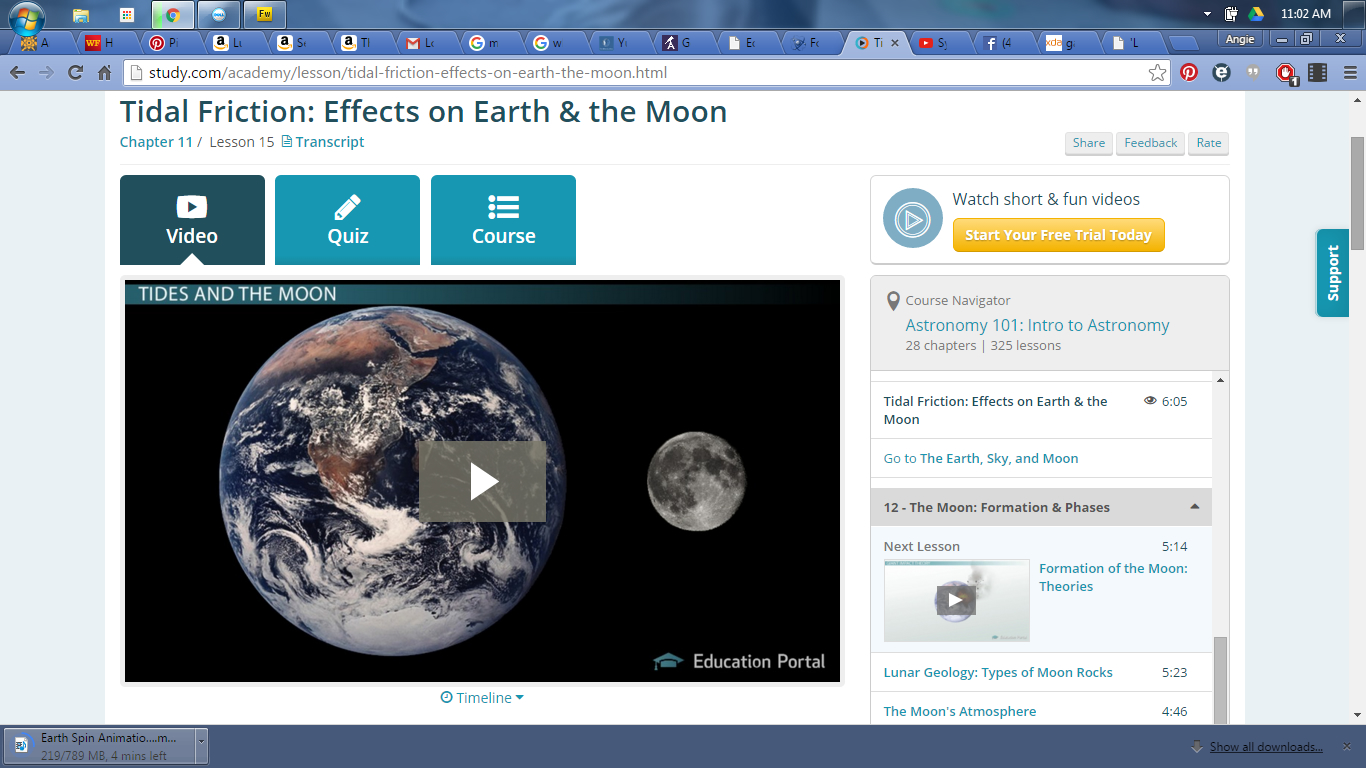
We watched the following video until it quit and asked us to sign up at $50/month for access… but it led to a few subsequent and related searches.
Tides affect the earth’s rotation in two sharply contrasting ways. One way, caused by tidal friction, produces an extremely slow secular change in rotation. The other way, caused by the continual movements of the tides about the planet, produces very small but very rapid changes in rotation. These rapid changes occur at exactly the same periods as the tides themselves — half-daily, daily, etc. (The IERS Special Bureau for Tides is concerned primarily with the rapid changes, but some of our data have implications for the secular changes.)
The secular change in the planet’s rotation is a classical topic in geophysics. It goes back some 300 years to when Sir Edmond Halley first hypothesized that the moon was accelerating in its orbit. Most of Halley’s lunar acceleration was only apparent. It was actually the earth’s rotation slowing down, making the moon appear to accelerate. The moon does accelerate (strictly, it decelerates), but the larger effect is the earth’s rotational braking. This braking is caused by tidal friction. Throughout the earth’s history tidal braking has played, and it will continue to play, a dominant role in the rotation. Currently the secular change in the rotation rate increases the length of day by some 2.3 milliseconds per day per century.
To see what that means, consider this example: suppose the rotating earth is our clock and it’s been 100 years since that clock’s “standard second” was set to correspond to an atomic clock’s second (which is actually almost the case, notwithstanding that atomic clocks weren’t around until 1955). Then after 1000 days our earth clock loses about 2.3 seconds, falling further behind the atomic clock. This long-term slowing of the rotation is a primary reason for periodically inserting leap seconds into our timekeeping. Of course, there are other contributors to the changing rotation rate such as the changing atmosphere and the motions of the fluid core; one can’t blame just tides for our timekeeping difficulties.
The tidal braking in the earth’s rotation is actually caused primarily by friction in the oceans, where “friction” may refer to any number of physical mechanisms which have yet to be determined definitively. For example, bottom friction, induced by tidal currents flowing across the seabed, various kinds of wave breaking, and scattering of tidal waves into oceanic internal waves are all thought to play a role. For a recent overview of this subject, look up Walter Munk‘s paper “Once again: once again–tidal friction,” published in Progress in Oceanography, vol. 40, pp. 7-36, 1997.
Planetary Gravity
Obviously, gravity is very important on Earth. The Sun’s gravitational pull keeps our planet orbiting the Sun. The motion of the Moon is affected by the gravity of the Sun AND the Earth. The Moon’s gravity pulls on the Earth and makes the tides rise and fall every day. As the Moon passes over the ocean, there is a swell in the sea level. As the Earth rotates, the Moon passes over new parts of the Earth, causing the swell to move also. The tides are independent of the phase of the moon. The moon has the same amount of pull whether there is a full or new moon. It would still be in the same basic place.
We have to bring up an important idea now. The Earth always produces the same acceleration on every object. If you drop an acorn or a piano, they will gain velocity at the same rate. Although the gravitational force the Earth exerts on the objects is different, their masses are just as different, so the effect we observe (acceleration) is the same for each. The Earth’s gravitational force accelerates objects when they fall. It constantly pulls, and the objects constantly speed up.
What About the Moon?
But what keeps the Moon from falling down, if all of this gravity is so strong? Well, the answer is that the moon IS falling; all the time, but doesn’t get any closer to us! Remember that if there wasn’t a force acting, the Moon would be traveling in a straight line. Because there IS a force of attraction toward the Earth, the moon “falls” from a straight line into a curve (orbit) around the Earth and ends up revolvingaround us. The Earth’s gravity holds it in orbit, so it can’t just go off in a straight line. Think about holding a ball on a string and spinning it in a circle. If you were to cut that string (no more gravity), the ball would fly off in a straight line in the direction it was going when you cut the string. That direction, by the way, is not directly away from your hand, but tangent to the circle. Tangent is a geometry term used to describe a direction that are related to the slope of a curve. The pull of the string inward (toward your hand) is like the Earth’s gravitational pull (inward toward the center of the Earth).
This video brings up a significant question, however, that led to more research. Back to the moon’s phases (the original book that led to all this), it appears, according to this video, that the tidal forces on our oceans, thanks to the moon, are relevant to the positioning of the moon’s angle from the sun. However, other information we’ve read indicate that the phases have no effect.. SO, here we go –
Here’s what we came up with:
Then, Lily asked, “WHAT IF MOON WASN’T THERE, OR IF IT KEEPS GETTING FURTHER AWAY AND LEAVES THE EARTH?”
So, we went hunting for some input….
From: https://propelsteps.wordpress.com/2013/09/06/know-what-if-earth-does-not-have-moon/
The question arose one evening after Christmas, fittingly beneath a nearly full Moon. What if this bright sphere we are so accustomed to in the sky just weren’t there? How would our planet get by without it?
A few consequences come immediately to mind: Neil Armstrong’s life would have been less exciting. Audrey Hepburn wouldn’t have sat on the stairs with a guitar and played “Moon River” in the movie Breakfast at Tiffany’s. And the myth of werewolves wouldn’t have existed – at least not in the form we know it today.
And of course it would be darker at night.
But what major outcome would it have on the Earth in general?
We contacted Kaare Aksnes, professor emeritus at the Institute for Theoretical Astrophysics at the University of Oslo for an answer.
“In short we would have less difference between high and low tides, shorter days and a more extreme climate,” he says.
Half the tides
Lunar gravitation is greater on the side of Earth facing the Moon than it is on thecentre of our planet. And its gravitational attraction on the centre of the Earth is stronger than on the opposite side of our planet. This makes ocean water bulge outward on either side of the planet.

Because of the Earth’s rotation this gives us high tides twice a day, followed by low tides about 6 hours later.
“We would have less sustantial high and low tides without the Moon. However, there would still be tides, because the Sun also has a tidal effect, although it only amounts to about half that of the Moon,” explains Aksnes.
The Sun is much more massive, but also much further away than the Moon. Even though the Sun pulls on the oceans more than the Moon does, the difference between its pull on the front and back sides of the Earth is less than the case is with the Moon, and it’s this difference that determines the height of the tidal bulge.
Shorter workdays
The pulling of the seas toward the Moon not only affects seawater depths along the coasts. The Earth’s rotation is slowed down by what is called tidal friction.
The movement of the bulge of tidal water across the oceans and its attraction to the Moon acts as a brake on the Earth’s rotation. Slowly but surely the length of a day is increasing.
“We’re not talking about a heavy foot on the brake pedal – it amounts to about two seconds per 100,000 years. But on a cosmic scale 100,000 years is a fairly short time. So if the Moon didn’t exist, the Earth would be spinning much faster now and a day would be several hours shorter,” says Aksnes.
That would be great for those fighting for shorter workdays.

The Moon is our hammer
Perhaps the most important effect of the Moon is the way it stabilizes our rotation. When the Earth rotates it wobbles slightly back and forth on its axis. It’s like a top, which doesn’t simply spin in a vertical position on a table or the floor. But without the Moon we’d be wobbling much more.
“The relevant link between spin and orbit is very complicated, but in a simplified version you could think of it as being like an Olympic athlete in the hammer throw event,” says Terje Wahl, deputy director general of the Department of Space and Earth Sciences at the Norwegian Space Centre.
“When a hammer thrower spins around before letting go he could nearly be rotating on a pinpoint. But as soon as he releases the hammer he takes a couple of awkward steps and flails his arms to keep from falling down,” Wahl explains.
While there are some differences between the Earth-Moon system and the hammer thrower, one being that the hammer and the hammer thrower spin at the same speed, whereas the Earth and Moon don’t, the result is the same:
The Moon keeps the Earth from wobbling violently as it spins.
North Pole in Congo
“Without the Moon the tilt of the Earth’s axis would vary more, with potentially strong climatic effects,” says Aksnes.

With no moon as a stabilizer, the Earth would sometimes tilt all the way over and lie on its side in relation to its orbit around the Sun. This would make for extreme differences between temperatures and daylight throughout the year.
At other times the Earth’s axis would be straight up and down, making night and day equally long, year round, and there would be no seasons.
There would be periods with more extreme weather, and bigger differences between winter and summer.
“A good example of this is Mars, which has no large moon to stabilize it, so it tilts more. The Martian climate and atmosphere has undergone enormous changes in the past millions of years. We probably would see something similar to that here,” says Aksnes.
On Mars the axis tilts so much that the ice now found at its poles has sometimes moved all the way down to the equator. A similar scenario here, with large portions of Africa being covered in ice at intervals, would be rather inconvenient.
The Moon and the menstrual cycle are unrelated
For women it might seem like this issue has another dimension, because we, like the tides, are linked to a monthly cycle. Is the menstrual cycle really related to the Moon, or is their length just a coincidence? After all, the moon has a period.
Britt Ingjerd Nesheim is a professor and physician in obstetrics and gynaecology at the University of Oslo, and has a ready answer.

“There isn’t any connection between the menstrual cycle and the lunar cycle, it’s just a coincidence that they are about the same,” she says.
“Several studies have been made to check whether any of the myths about the Moon’s impact on us are correct. For instance it’s been believed for some time that more childbirths occur during a full Moon than otherwise, but it turns out this isn’t the case either.”
It isn’t all that long ago that insanity was thought to be linked to the Moon. It was pseudo-scientifically argued that since the brain consists of about 80 percent water, lunar phenomena would disturb the aquatic balance in our heads – just like with tides – hence causing lunacy.
Of course both sides of our heads are effectively the same distance from the Moon and the only thing loony here is the myth.
We could have evolved without the Moon
Our world would certainly be quite different if it had no large satellite. But apparently it would not be so radically different that its absence would necessarily prevent humans from ever seeing the light of day.
Another question is what would happen if the Moon were to suddenly decide to say goodbye. Would we survive that?
“Yes we would. Nothing too severe would happen because the Moon could never vanish instantaneously. It would slowly get further away and eventually leave us. But there’s nothing indicating that we’ll lose the Moon, so this is purely hypothetical,”Aksnes assures us.

The Moon actually is in the process of leaving us, at a rate of nearly four centimetres a year. Neither the oceanic tides nor the length of the day are particularly crucial to our survival, so the most important aspect of this separation is the way the changes in the Earth’s tilt would impact us.
“I would expect the Earth to still be habitable, even when considering large changes in the axis. The Earth can be compared to a spinning top. The force of its rotation makes it relatively stable. Despite losing the stabilizing Moon it would take a long time before the tilt of Earth’s axis changed much,” Aksnes points out.
“If for instance you look at the life expectancy of a civilization as a few thousand years, the changes would be so slowly paced that we could have time to adapt.”
If you are still nervous about what will happen eventually as the Moon orbits further and further away, you might find solace in the following: By the time any serious consequences could occur, the Sun will have become a red giant and will have consumed both the Earth and the Moon.
__________
Courtesy & Source : Sciencenordic.com, YouTube and Google
Related articles
- facts about the moon (team21jeaneve.wordpress.com)
- Is the Moon a planet? (mannaismayaadventure.com)
- Laser-Equipped NASA Orbiter Is Bringing Broadband to the Moon(mashable.com)
- Beyond Planet Earth: Astronomy ( Artefacts 1 and 2 )(solomoneu.wordpress.com)
- The Moon (Mind Bomb #011) – You Just Got to Read This(okjdiscoveries.wordpress.com)
- The Moon As A Stabilizing Influence (nrhatch.wordpress.com)
- The top 5 things we’d miss if we didn’t have a Moon [Starts With A Bang](scienceblogs.com)
- The Lonely Moon (ellemedit1234.wordpress.com)
Eventually, we watched this quick video and talked about a planet 10x’s the size of Jupiter… and star’s tides.
http://phys.org/news/2009-08-planet-shouldnt-video.html
Found: The planet that shouldn’t exist (w/ Video)
August 26, 2009

(PhysOrg.com) — The ‘most unlikely’ discovery of a new planet which could spiral into its star within the next 500,000 years, has been made by Scottish astronomers.
The find, by an international team including the University of St Andrews, is so bizarre that odds on catching it at this late stage in its life were 1000-1.
The ‘huge new planet’, found orbiting a star 1000 light years away, was discovered by the UK’s WASP project, of which St Andrews is a founding member.
Newly-christened WASP-18b, the planet is so massive and so close to its host star that it is almost certain to spiral inwards to its destruction during the lifetime of the star.
Researchers from St Andrews are currently calculating the rate at which tidal interactions between star and planet will eventually cause the planet’s orbit to decay completely.
St Andrews’ physicist, Professor Andrew Collier Cameron said, “This is another bizarre WASP planet discovery. The situation is analogous to the way tidal friction is gradually causing the earth’s spin to slow down, and the Moon to spiral away from the earth.
“In this case, however, the spin of the star is slower than the orbit of the planet – so the star should be spinning up, and the planet spiralling in.”
WASP-18b is ten times the mass of Jupiter and orbits its star in less than one Earth-day. The new planet belongs to a now-common class of extrasolar planets known as ‘hot Jupiters’ – massive planets thought to have formed far from their host stars that migrated inwards over time.
The discovery, led by Keele University’s Coel Hellier, suggests that WASP-18’s parent star is about a billion years old – making the likelihood of observing WASP-18b about one in a thousand.
If the planet’s remaining life is as short as predicted, its orbital decay should be measurable within a decade.
Professor Cameron continued, “We don’t yet know how long the planet will survive, because we don’t understand fully how tides operate on the Sun and other stars. It could be half a million years, or half a billion. But if it’s spiralling in quickly, we should be able to see measurable changes in the orbit within ten years.”
Provided by University of St Andrews
 Explore further: Missing planets attest to destructive power of stars’ tides
AND THIS, was just cool