Angie Nixon Ok, so I think the point of Lily’s pondering, as well as my own, was trying to wrap our heads around just really how far away the thing is from us. Concrete thinking at the age of 6, distance is measured in how long a certain story or movie is, but that aside, she was learning about the concept of size and ratio today, as a result of these questions.
I used a grain of salt as compared to our house to explain 1 to a 12 million light year’s worth of distance. Is this accurate? It didn’t matter, she got the point of the magnitude of distance, along with discussions that proceeded to talk of the size of our planet, our sun, galaxy, etc.. It was an exercise in trying to help her gain some perspective for something that she was grappling with.
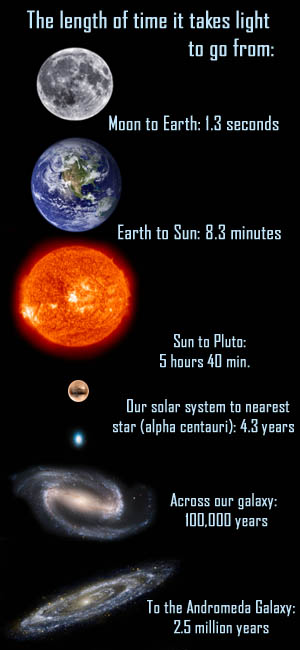
So, we talked of how many seconds are in a minute, minutes in an hour, hours in a day, days in a year. (Much to my surprise, Lily knew these! I didn’t know she knew this.) We then talked of how many seconds were in a day, then a year, and how we calculate this. We discussed the increments of light seconds to light years, and learned that it would take 1.3 light seconds for us to get to the moon, which in terms of travel options we have utilized in the last 50 years, that translates to 3-4 human days (or orbits – w
hich she also learned why our days are the length they are, and asked then about whether days and nights are the same amount of time, which led to discussion on the tilt of the earth, etc.. It’s been a big day). @Thierry, I’m uncertain what you mean that I need to write differently? I’m stretching a good bit here anyway, as my childhood education was more interested in telling me the value of avoiding science and math, than embracing it, inaccuracy and all). Can you clarify?
I found this page just now:
http://www.unmuseum.org/speed.htm“Light travels at a speed of 186,000 miles a second or 700 million miles an hour.”
So, a little math, which is not my forte, allows us to put this into perspective.
The variable I am missing is how the distance with speed of travel work. I can figure for the constant of how fast I’d have to go to get some specified distance, given a specified speed, but I can’t work it the opposite direction, where I don’t have a “miles” distance (or other measure besides light years). I am certain there is a formula…. looking now at Thierry’s link.
Pondering Aaron’s speed of sound…
The Speed of 
 Light travels at a speed of 186,000 miles a second or 700 million miles an hour. For scale, the distance from the Earth to the Moon is about 239,000 miles. This seems pretty fast and indeed theory says that nothing can travel faster than the speed of light.
In our every day lives light seems to travel from one place to another instantaneously. When we flip on the light in a room there is no delay between when we first see the bulb start glowing and when light illuminates the far corners of the chamber. Our nervous systems are much too slow to notice the rays of light that appear from the bulb and move like a wave washing over the room.
When we deal with the immense distances of space, though, even light seems slow. When astronauts were on the Moon it took over a second for the radio waves (which travel at the speed of light) carrying their voices to reach us. Light coming from the sun takes eight and one half minutes to hit Earth. (This means that if the sun were suddenly to go dark, it would take over eight minutes for us to notice) Light from the nearest stars, other than the sun, takes four and a half years to get here. From the farthest stars in distant galaxies it can take billions of years for the light to arrive..
The distance light can travel in a year is called a “light year.” The light year is one of the basic measures of distance for astronomy.
When designing probes for trips to other planets in our solar system it is important for the planners to keep the communications time lag, caused by the speed of light, in mind. For example, a probe designed to land on Mars must be smart enough to handle problems in the flight on its own without instructions from Earth. If a course change is needed during landing the probe would have to do it automatically. The delay caused by the probe requesting instructions from Earth and getting commands back might be nearly an hour, plenty of time for the probe to crash.
The delay caused by the speed of light can sometimes be noticed here on Earth during telephone calls. Long distance calls that have been routed over one or more space satellites may cause a half second or so delay between the speaker and the listener.
The speed of light has several properties which may seem counter-intuitive to us, but are true:
-Nothing travels faster than the speed of light.
-No matter how fast you are moving the speed of light seems to be the same speed as if you were not moving at all.
-As an object or person is accelerated toward the speed of light time slows down for it/him.
This last property leads to the “twins” effect: Twin brothers live on Earth. One brother takes a trip to a distant star traveling at a high percentage of the speed of light. When the twin returns he will be younger than his brother because for him time slowed down during the trip.
This effect, called “time dilation,” helps explain why the speed of light is the same no matter how fast you are going. As a traveler accelerates time slows down for him. This, in turn, affects his measurements.
Copyright Lee Krystek 1996-2013. All Rights Reserved.
______________________________________________________________________
Now we are on to what the spinal cord attaches to first (she pulled a book out instead of Googling it this time, and started researching the answer to her question for herself), which portion of the brain commands a higher initial and sustaining priority of nerves and responses, and whether it’s like a line that each signal has to wait in at a gate to get to its respective part of the brain for processing, or whether it’s more like a floodgate that is just perpetually open.
Then, she asked me how the brain determines scent and aroma. – We were removing old linoleum from the laundry room floor.
Oh, a typical day.And a few days ago, for which
Russ Nixon was for once, present to witness, Lily asked why we breathe. Suffice it to say, my initial response of “well, surviv…”, “Yes, I know it’s necessary for our survival.”, a somewhat annoyed 6 year old retorts, and then continues.
“What I want to know is why. Why do we breathe. Why do we breathe oxygen instead of something else? Why breathing?”, asks a Lily from the back seat, to two parents who begin to try to answer with um, deep breaths.
Eventually, discussion of the elements found common to water and air, the extrapolation of oxygen from the water by sea creatures and such with gills, the amount of oxygen coming from water laden atmosphere, and ultimately, we talked of the connectedness of life, carbon, the idea that life cannot survive without water, the aspect where water has more elements than oxygen alone, but that we don’t breathe pure oxygen, and where oxygen comes from (the plant part is too simple, she learned about that with Russ’s illness this year, she thinks there’s more too it). Take a breath… But then she asked again, why.
Alas, Russ and I responded how much we appreciated her sharing such questions and thoughts with us… and told her, as we have had to too many times already in her short life, “Well, thankfully we have the internet, because I don’t know yet, but we will both know soon.”


