Lily chose to be Aisling for Halloween.
I am going to use this post as a starting/reference point. Because of her choice of character, and the associated story, we have begun to explore the Middle Ages, Europe in antiquity, myth and legend, and the Irish language. Oh, how much fun this is!




The movie, “The Secret of Kells”, talks about an ancient Irish story during the 9th century, when the Norsemen (Vikings) were invading the Irish (and most of Europe).
Aisling (Ashlain) is a character that is somewhat a fairie, in that she protects the forest. She is also a changling, most often assuming the form of a wolf, but can become whatever she needs or chooses. During the point in the story when Brendan is attempting to retrieve the Eye of Collum-Cille

I love allowing her awareness and her mind’s education to unfold organically.
If she were in school, she’d be corrected as if she’d done something in error (see above letter). Not here. 🙂 Here, she can develop at her pace, with guidance. I don’t have to correct her… she observes for herself because she reads. She will ask sometimes whether her version is the “right” way, and we more often than not, are able to tell her that her version makes perfect sense. Sometimes we add that there are other ways of spelling something, and we demonstrate. WE don’t have to tell her correct or not – she is assimilating and assessing on her own and self correcting. And while she’s at it, she’s making sense of things in a solid and fundamentally thorough manner that children in our standard education will never have the chance to do.
Last night, twice while she slept soundly, she started singing this song (shown in video). Russ and I both heard it! I wanted to catch it on video but I wasn’t awake enough and each event was too quick. Her tone and the melody came out clearly, and dead on accurate. Russ says he didn’t make sense of any words, but the second time I heard her sing, I heard the words clearly. She was sound asleep.
I love the brain!
http://youtu.be/zCnkanYUQMo


The lyrics are a mixture of English and Irish (Gaelic).
You must go where I cannot,
Pangur Ban Pangur Ban,
Nil sa saol seo ach ceo,
Is ni bheimid beo,
ach seal beag gearr.
Pangur Ban Pangur Ban,
Nil sa saol seo ach ceo,
Is ni bheimid beo,
ach seal beag gearr.
Literal Translation:
You must go where I cannot,
Pangur Ban Pangur Ban,
There is nothing in this life but mist,
And we are not alive,
but for a little short spell.
Pangur Ban Pangur Ban,
There is nothing in this life but mist,
And we are not alive,
but for a little short spell.

Pangur Ban
- Messe [ocus] Pangur bán,
- cechtar nathar fria saindán;
- bíth a menma-sam fri seilgg,
- mu menma céin im saincheirdd
- Caraim-se fós, ferr cach clú,
- oc mu lebrán léir ingnu;
- ní foirmtech frimm Pangur bán,
- caraid cesin a maccdán.
- Ó ru-biam scél cén scis
- innar tegdias ar n-oéndis,
- táithiunn dichríchide clius
- ní fris ‘tarddam ar n-áthius.
- Gnáth-huaraib ar greassaib gal
- glenaid luch ina lín-sam;
- os me, du-fuit im lín chéin
- dliged ndoraid cu n-dronchéill.
- Fúachaid-sem fri freaga fál
- a rosc a nglése comlán;
- fúachimm chéin fri fégi fis
- mu rosc réil, cesu imdis.
- Fáelid-sem cu n-déne dul,
- hi nglen luch ina gérchrub;
- hi-tucu cheist n-doraid n-dil,
- os mé chene am fáelid.
- Cia beimini amin nach ré
- ní derban cách a chéle;
- mait le cechtar nár a dán
- subaigthiud a óenurán.
- Hé fesin as choimsid dáu
- in muid du-n-gní cach óenláu;
- do thabairt doraid du glé
- for mumud céin am messe.
| “The Scholar and the Cat” | “From the Irish of Pangur Ban” |
| by Frank O’Connor | by Eavan Boland |
| Each of us pursues his trade, I and Pangur my comrade, His whole fancy on the hunt, And mine for learning ardent.More than fame I love to be Among my books and study, Pangur does not grudge me it, Content with his own merit.When a heavenly time! we are In our small room together Each of us has his own sport And asks no greater comfort.While he sets his round sharp eye On the wall of my study I turn mine, though lost its edge, On the great wall of knowledge.Now a mouse drops in his net After some mighty onset While into my bag I cram Some difficult darksome problem.When a mouse comes to the kill Pangur exults, a marvel! I have when some secret’s won My hour of exultation. Though we work for days and years Neither the other hinders; Each is competent and hence Enjoys his skill in silence. Master of the death of mice, He keeps in daily practice, I too, making dark things clear, Am of my trade a master. |
Myself and Pangur, cat and sage Go each about our business; I harass my beloved page, He his mouse.Fame comes second to the peace Of study, a still day Unenvying, Pangur’s choice Is child’s play.Neither bored, both hone At home a separate skill Moving after hours alone To the killWhen at last his net wraps After a sly fight Around a mouse; mine traps Sudden insight.On my cell wall here, His sight fixes, burning, Searching; my old eyes peer At new learning,And his delight when his claws Close on his prey Equals mine when sudden clues Light my way. So we find by degrees Peace in solitude, Both of us, solitaries, Have each the trade He loves: Pangur, never idle Day or night Hunts mice; I hunt each riddle From dark to light. |
St. Columcille of Iona
http://www.irishcultureandcustoms.com/ASaints/Columcille.html
by Bridget Haggerty
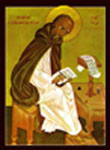 Around the same time that St. Patrick was taken to Ireland as a slave, Columcille (who was also known as Columba, Colum, Columbus, Combs, and Columkill),was born on December 7th 521 AD in Gartan, Co. Donegal. He came from a race of kings who had ruled in Ireland for six centuries and was himself in close succession to the throne.
At an early age, he was given in fosterage to a priest. After studying at Moville under Saint Finnian and then at Clonard with another Saint Finnian, he surrendered his princely claims, became a monk at Glasnevin under Mobhi, and was ordained.
He spent the next 15 years preaching and teaching in Ireland. As was the custom in those days, he combined study and prayer with manual labor. By his own natural gifts as well as by the good fortune of his birth, he soon gained ascendancy as a monk of unusual distinction.
By the time he was 25, he had founded no less than 27 Irish monasteries, including those at Derry, Durrow and Kells.
Columcille was also a poet who had learned Irish history and poetry from a bard named Gemman. In addition, he loved fine books and manuscripts. One of the famous books associated with Columcille is the Psaltair, which was traditionally the Battle Book of the O’Donnells, his kinsmen, who carried it into battle.
Illuminated manuscript

In the strictest definition of illuminated manuscript, only manuscripts with gold or silver, like this miniature of Christ in Majesty from theAberdeen Bestiary (folio 4v), would be considered illuminated.

The decoration of this page from a French Book of Hours, ca.1400, includes a miniature, initials and borders
An illuminated manuscript is a manuscript in which the text is supplemented by the addition of decoration, such as decorated initials, borders (marginalia) and miniature illustrations. In the most strict definition of the term, an illuminated manuscript only refers to manuscripts decorated withgold or silver, but in both common usage and modern scholarship, the term is now used to refer to any decorated or illustrated manuscript from the Western traditions. Comparable Far Eastern works are always described as painted, as are Mesoamerican works. Islamic manuscripts may be referred to as illuminated, illustrated or painted, though using essentially the same techniques as Western works.
The earliest surviving substantive illuminated manuscripts are from the period AD 400 to 600, initially produced in Italy and the Eastern Roman Empire. The significance of these works lies not only in their inherent art historical value, but in the maintenance of a link of literacy offered by non-illuminated texts as well. Had it not been for the monastic scribes of Late Antiquity, most literature of Greece and Rome would have perished inEurope; as it was, the patterns of textual survivals were shaped by their usefulness to the severely constricted literate group of Christians. Illumination of manuscripts, as a way of aggrandizing ancient documents, aided their preservation and informative value in an era when new ruling classes were no longer literate.
The majority of surviving manuscripts are from the Middle Ages, although many illuminated manuscripts survive from the Renaissance, along with a very limited number from Late Antiquity. The majority of these manuscripts are of a religious nature. However, especially from the 13th century onward, an increasing number of secular texts were illuminated. Most illuminated manuscripts were created as codices, which had supersededscrolls. A very few illuminated manuscript fragments survive on papyrus, which does not last nearly as long as vellum or parchment. Most medieval manuscripts, illuminated or not, were written on parchment (most commonly of calf, sheep, or goat skin), but most manuscripts important enough to illuminate were written on the best quality of parchment, called vellum.
Beginning in the late Middle Ages manuscripts began to be produced on paper.[1] Very early printed books were sometimes produced with spaces left for rubrics and miniatures, or were given illuminated initials, or decorations in the margin, but the introduction of printing rapidly led to the decline of illumination. Illuminated manuscripts continued to be produced in the early 16th century, but in much smaller numbers, mostly for the very wealthy.
Manuscripts are among the most common items to survive from the Middle Ages; many thousands survive. They are also the best surviving specimens of medieval painting, and the best preserved. Indeed, for many areas and time periods, they are the only surviving examples of painting.
Iona & Kells
Iron gall ink
_sulfate_-_California_State_Archives.jpg)
Oak galls and iron(II) sulfate, ingredients of iron gall ink
Iron gall ink (also known as iron gall nut ink or oak gall ink) is a purple-black or brown-black ink made from iron salts and tannic acids from vegetable sources. It was the standard writing and drawing ink in Europe, from about the 5th century to the 19th century, and remained in use well into the 20th century.
Contents
[hide]
Preparation and use[edit]

Homemade ink. On left, solution of iron (from nails) and vinegar. On right, oak extraction. The two are mixed immediately prior to use to produce the ink, center.
The ink was generally prepared by adding some iron(II) sulfate (FeSO4) to a solution of tannic acid (C6H2(OH)3COOH), but any iron ion donor (e.g. nails,
__________________________________
Origin[edit]

Folio 27r from the Lindisfarne Gospelscontains the incipit Liber generationis of theGospel of Matthew. Compare this page with the corresponding page from the Book of Kells (see here), especially the form of theLib monogram.

The Book of Kells is one of the finest and most famous of a group of manuscripts in what is known as the Insular style, produced from the late 6th through the early 9th centuries in monasteries in Ireland, Scotland and England and in continental monasteries with Hiberno-Scottish or Anglo-Saxonfoundations.[1] These manuscripts include the Cathach of St. Columba, the Ambrosiana Orosius, fragmentary Gospel in the Durham Dean and Chapter Library (all from the early 7th century), and the Book of Durrow (from the second half of the 7th century). From the early 8th century come the Durham Gospels, the Echternach Gospels, the Lindisfarne Gospels (see illustration at right), and the Lichfield Gospels. Among others, the St. Gall Gospel Bookbelongs to the late 8th century and the Book of Armagh (dated to 807–809) to the early 9th century.[2] Scholars place these manuscripts together based on similarities in artistic style, script, and textual traditions. The fully developed style of the ornamentation of the Book of Kells places it late in this series, either from the late 8th or early 9th century. The Book of Kells follows many of the iconographic and stylistic traditions found in these earlier manuscripts. For example, the form of the decorated letters found in the incipit pages for the Gospels is surprisingly consistent in Insular Gospels. Compare, for example, the incipit pages of the Gospel of Matthew in the Lindisfarne Gospels and in the Book of Kells, both of which feature intricate decorative knot work patterns inside the outlines formed by the enlarged initial letters of the text. (For a more complete list of related manuscripts, see:List of Hiberno-Saxon illustrated manuscripts).[3]
The name Book of Kells is derived from the Abbey of Kells in Kells, County Meath, which was its home for much of the medieval period. The manuscript’s date and place of production have been the subject of considerable debate. Traditionally, the book was thought to have been created in the time of Columba,[4] possibly even as the work of his own hands. This tradition has long been discredited on paleographic and stylistic grounds: most evidence points to a composition date ca. 800,[5] long after St. Columba’s death in 597. The proposed dating in the 9th century coincides with Viking raids on Iona, which began in 794 and eventually dispersed the monks and their holy relics into Ireland and Scotland.[6] There is another tradition, with some traction among Irish scholars, that suggests the manuscript was created for the 200th anniversary of the saint’s death.[7]
The manuscript was never finished. There are at least five competing theories about the manuscript’s place of origin and time of completion. First, the book, or perhaps just the text, may have been created at Iona, then brought to Kells, where the illuminations were perhaps added, and never finished. Second, the book may have been produced entirely at Iona.[8] Third, the manuscript may have been produced entirely in the scriptorium at Kells. Fourth, it may have been produced in the north of England, perhaps at Lindisfarne, then brought to Iona and from there to Kells. Finally, it may have been the product of an unknown monastery in Pictish Scotland, though there is no actual evidence for this theory, especially considering the absence of any surviving manuscript from Pictland.[9] Although the question of the exact location of the book’s production will probably never be answered conclusively, the first theory, that it was begun at Iona and continued at Kells, is currently widely accepted.[1] Regardless of which theory is true, it is certain that the Book of Kells was produced by Columban monks closely associated with the community at Iona.

Medieval period[edit]
Kells Abbey was plundered and pillaged by Vikings many times in the 10th century, and how the book survived there is not known.[10] The earliest historical reference to the book, and indeed to the book’s presence at Kells, can be found in a 1007 entry in the Annals of Ulster. This entry records that “the great Gospel of Columkille, (Columba)[11] the chief relic of the Western World, was wickedly stolen during the night from the western sacristy of the great stone church at Cenannas on account of its wrought shrine”.[1][12] The manuscript was recovered a few months later—minus its golden and bejewelled cover—”under a sod“.[13] It is generally assumed that the “great Gospel of Columkille” is the Book of Kells.[14] If this is correct, then the book was in Kells by 1007 and had been there long enough for thieves to learn of its presence. The force of ripping the manuscript free from its cover may account for the folios missing from the beginning and end of the Book of Kells. The description in the Annals of the book as “of Columkille”—that is, having belonged to, and perhaps being made by Columba—suggests that the book was believed at that time to have been made on Iona.[15]
Regardless, the book was certainly at Kells in the 12th century, when land charters pertaining to the Abbey of Kells were copied onto some of its blank pages. The practice of copying of charters into important books was widespread in the medieval period, and such inscriptions in the Book of Kells provide concrete evidence about its location at the time.[1]
The Abbey of Kells was dissolved due to the ecclesiastical reforms of the 12th century. The abbey church was converted to a parish church in which the Book of Kells remained.
___________________________________________________________
Viking raids: 793–850
In the final decade of the 8th century CE, Norse raiders attacked a series of Christian monasteries located in the British Isles. In the British Isles, Christian monasteries had often been positioned on small islands and in other remote coastal areas so that the monks could dwell there in seclusion, devoting themselves to worship without the interference of other elements of society. At the same time, it made them isolated and un-protected targets for attack.[15] Historian Peter Hunter Blair remarked that the Viking raiders would have been astonished “at finding so many communities which housed considerable wealth and whose inhabitants carried no arms.”[15] These raids would have been the first contact many Norsemen had with Christianity, but such attacks were not specifically anti-Christian in nature, rather the monasteries were simply seen as ‘easy targets’ for raiders.[13]
The first known account of a Viking raid taking place in Anglo-Saxon England comes from 789, when three ships from Hordaland (in modern Norway) landed in the Isle of Portland on the southern coast of Wessex. They were approached by the royal reeve from Dorchester, whose job it was to identify all foreign merchants entering the kingdom, and they proceeded to kill him.[16] It is likely that other raids (the records for which have since been lost) occurred soon after, for in 792 King Offa of Mercia began to make arrangements for the defence of Kent from raids perpetrated by “pagan peoples”.[16]
The next recorded attack against the English came the following year, in 793, when the monastery at Lindisfarne, an island off of England’s eastern coast, was sacked by a Viking raiding party on 8 June.[16] The following year they sacked the nearby Monkwearmouth-Jarrow Abbey.[5]
In 795 they once again attacked, this time raiding Iona Abbey on Scotland’s west coast.[5] This monastery would be attacked again in 802 and 806, when 68 people dwelling there were killed. Following such devastation, the monastic community at Iona abandoned the site and fled instead toKells in Ireland.[17]
In the first decade of the 9th century CE, Viking raiders began to attack coastal districts along Ireland.[18] In 835, the first major Viking raid in southern England took place and was directed against the Isle of Sheppey.[19]
http://www.thenagain.info/webchron/westeurope/VikingRaids.html
http://imagejournal.org/page/blog/revealing-the-secret-of-kells-part-2