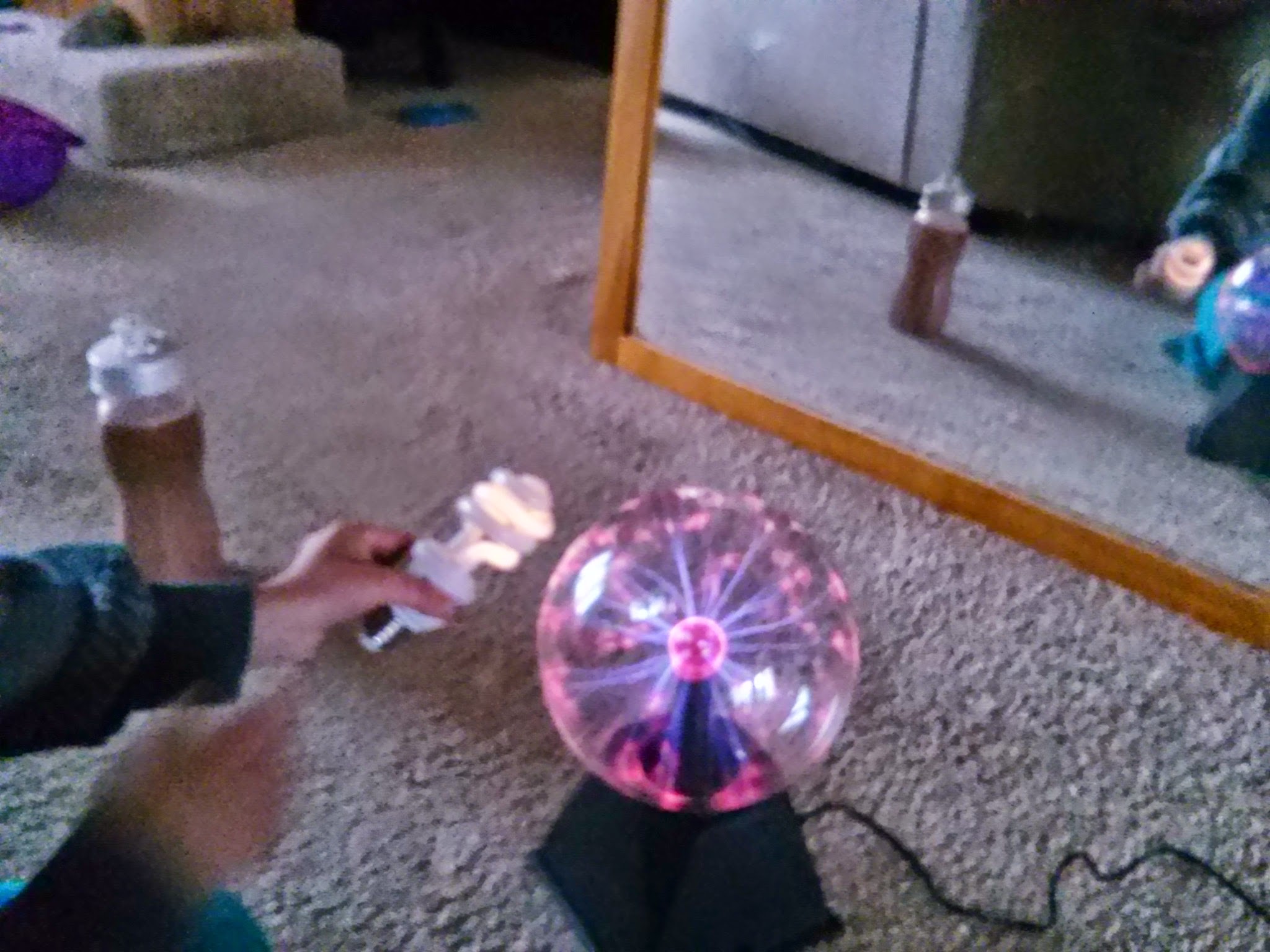
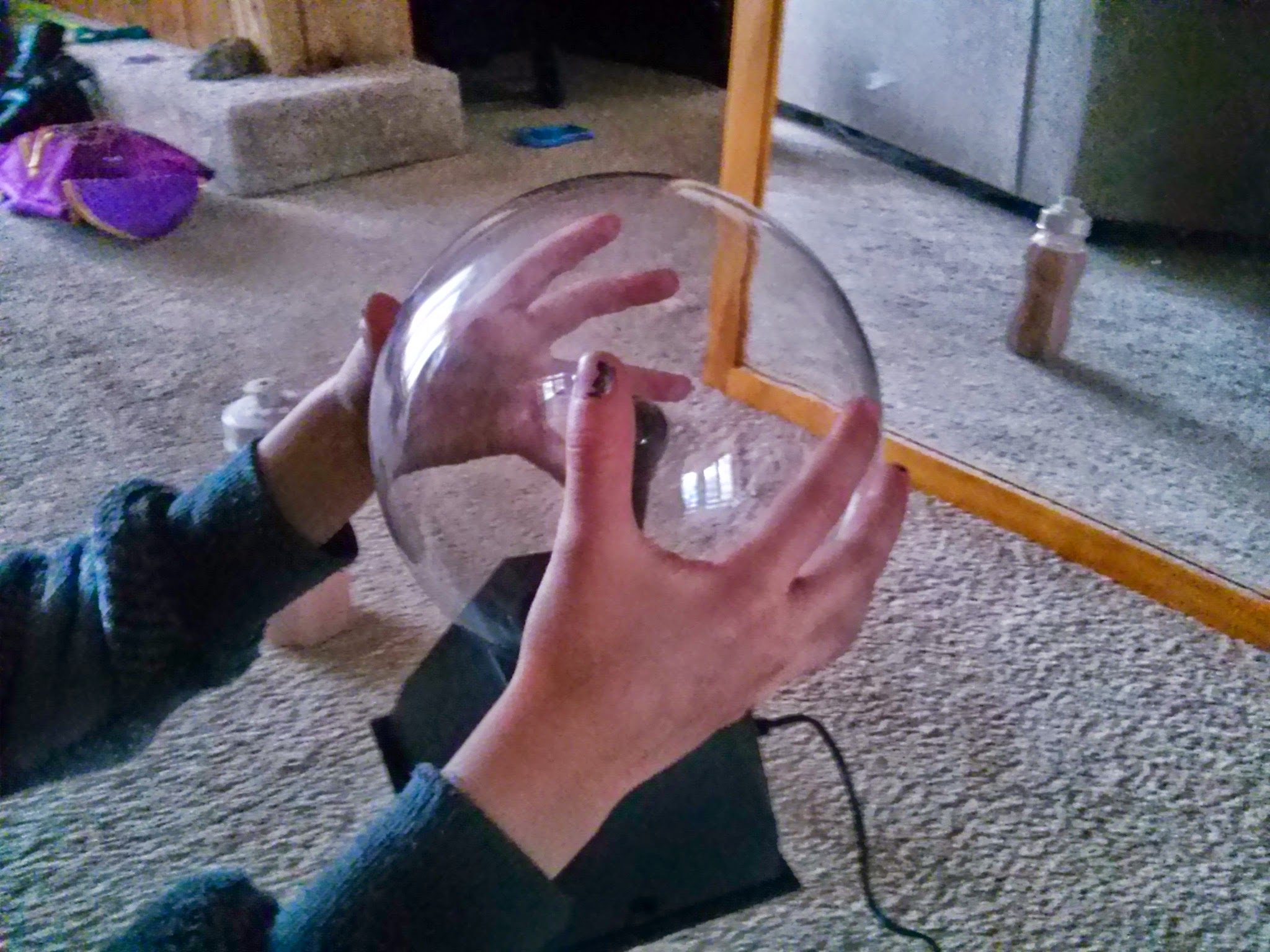
A spin off the electricity/circuitry sessions for this week…
Coming up next…. Lasers
Seeing light in a new way
Scientists coax photons to bind into molecules for first time

Working with colleagues at the Harvard-MIT Center for Ultracold Atoms, a group led by Harvard Professor of Physics Mikhail Lukin and MIT Professor of Physics Vladan Vuletic managed to coax photons into binding together to form molecules — a state of matter that until recently had been purely theoretical. The work is described in a Sept. 25 paper in Nature.
The discovery, Lukin said, runs contrary to decades of accepted wisdom about the nature of light. Photons have long been described as massless particles that don’t interact with each other. Shine two laser beams at each other, he said, and they simply pass through one another.
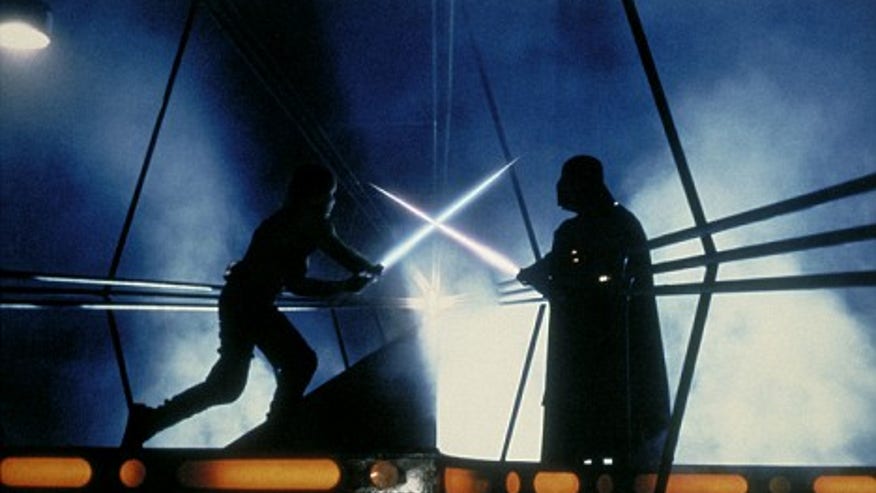
Photonic molecules, however, behave less like traditional lasers and more like something you might find in science fiction: the light saber.
“Most of the properties of light we know about originate from the fact that photons are massless, and that they do not interact with each other,” Lukin said. “What we have done is create a special type of medium in which photons interact with each other so strongly that they begin to act as though they have mass, and they bind together to form molecules. This type of photonic bound state has been discussed theoretically for quite a while, but until now it hadn’t been observed.
“It’s not an inapt analogy to compare this to light sabers,” Lukin said. “When these photons interact with each other, they’re pushing against and deflecting each other. The physics of what’s happening in these molecules is similar to what we see in the movies.”
To get the normally massless photons to bind to each other, Lukin and his colleagues, including Harvard postdoctoral fellow Ofer Firstenberg, former Harvard doctoral student Alexey Gorshkov, and MIT graduate students Thibault Peyronel and Qiu Liang, couldn’t rely on something like the Force. They instead turned to a set of extreme conditions.
Researchers began by pumping rubidium atoms into a vacuum chamber, then used lasers to cool the cloud of atoms to just a few degrees above absolute zero. Using extremely weak laser pulses, they fired single photons into the cloud of atoms.
As the photons enter the cloud, Lukin said, their energy excites atoms along its path, causing the photons to slow dramatically. As the photons move through the cloud, that energy is handed off from atom to atom, and eventually exits the cloud with the photon.
“When the photon exits the medium, its identity is preserved,” Lukin said. “It’s the same effect we see with refraction of light in a water glass. The light enters the water, it hands off part of its energy to the medium, and inside it exists as light and matter coupled together. But when it exits, it’s still light. The process that takes place is the same. It’s just a bit more extreme. The light is slowed considerably, and a lot more energy is given away than during refraction.”
When Lukin and his colleagues fired two photons into the cloud, they were surprised to see them exit as a single molecule.
The reason they form the never-before-seen molecules? It’s an effect called a Rydberg blockade, Lukin said, which means that when an atom is excited, nearby atoms cannot be excited to the same degree. In practice, the effect means that as two photons enter the atomic cloud, the first excites an atom, but it must move forward before the second photon can excite nearby atoms.
The result, he said, is that the two photons push and pull each other through the cloud as their energy is handed off from one atom to the next.
“It’s a photonic interaction that’s mediated by the atomic interaction,” Lukin said. “That makes these two photons behave like a molecule, and when they exit the medium they’re much more likely to do so together than as single photons.”
While the effect is unusual, it has some practical applications.
“We do this for fun, and because we’re pushing the frontiers of science,” Lukin said. “But it feeds into the bigger picture of what we’re doing because photons remain the best possible means to carry quantum information. The handicap, though, has been that photons don’t interact with each other.”
To build a quantum computer, he said, researchers need to build a system that can preserve quantum information and process it using quantum logic operations. The challenge, however, is that quantum logic requires interactions between individual quanta so that quantum systems can be switched to perform information processing.
“What we demonstrate with this process allows us to do that,” Lukin said. “Before we make a useful, practical quantum switch or photonic logic gate, we have to improve the performance. So it’s still at the proof-of-concept level, but this is an important step. The physical principles we’ve established here are important.”
The system could even be useful in classical computing, Lukin said, considering the power-dissipation challenges that chip-makers face. A number of companies, including IBM, have worked to develop systems that rely on optical routers that convert light signals into electrical signals, but those systems face their own hurdles.
Lukin also suggested that the system might one day even be used to create complex, 3-D structures, such as crystals, wholly out of light.
“What it will be useful for we don’t know yet. But it’s a new state of matter, so we are hopeful that new applications may emerge as we continue to investigate these photonic molecules’ properties,” he said.
http://www.physics.org/article-questions.asp?id=59
Are lightsabers possible?
 Lightsabers are a genius idea: portable, lightweight, activated with the flick of a switch and oozing cool (at least if you’re a Star Wars fan). To create the saber’s shining blade of light, laser technology seems the obvious choice. Laser produces a highly directional light beam which can be used for everything from etching metal surfaces to eye surgery, so why not battling the dark side? Unfortunately, it’s not as simple as it looks.
Problem #1: Creating a short blade
Probably the most fundamental issue is that a lightsaber’s blade needs to stop short after a couple of feet. But a laser beam, just like any kind of light, never just ‘stops’, unless something in its way absorbs or reflects the energy.
A laser-powered lightsaber would therefore be extremely unwieldy, not to mention constituting a real health and safety nightmare. Allow the slightest lapse of attention during a battle and you could accidentally decapitate your best friend or slice off your own toes.
One solution would be to cap the end of blade with a mirror to confine the beam, but this would mean that you couldn’t stab anyone. Plus, building a structure to hold the cap in place would take all the elegance and grace out of a lightsaber.
Problem #2: Size
Producing a high-powered laser beam requires a lot of kit. Although some pretty amazing advances in technology have seen high power lasers shrink in size, you’d also need some kind of cooling system to prevent the system from overheating. This fundamental requirement means you’d be hard pressed to build a light saber that you could physically carry on your back, let alone pull off any fancy sword tricks with.
Problem #3: Powering the blade
This brings us on to the question of power. Lasers strong enough to do any proper damage need serious amounts of energy, so your light saber couldn’t run on standard batteries. You’d probably have to plug yourself into the mains – which might not go down so well on an enemy ship (even if the ship’s owner was actually your dad).
Problem #4: More combat issues
Since as we’ve seen, a laser beam is easily reflected, it would be easy for your opponent to shield themselves with a mirror, or even turn your lightsaber’s blade back against you: possibly a bit embarrassing.
What’s more, clashing lightsaber blades would be impossible – the beams would just pass straight through each other and make for a very boring duel.
Problem #5: Visual and audio effects
Half the reason lightsabers are cool derives from their colourful glow and swooshy noises. Unfortunately, a laser beam can’t be seen from the side (unless the air is particularly smoky or dusty – that’s why lasers are always used in conjunction with smoke machines in clubs or concert venues). Just like an oversized laser pointer, a light saber would be basically invisible. Unless of course it was directed straight into your eye, in which case it would probably be the last thing you ever saw.
And in the same way that waving a torch around doesn’t make any noise, you’ve guessed it, swinging your lightsaber would be silent. And let’s face it, even Luke Skywalker would look pretty pathetic wielding an invisible and silent sword.
In conclusion, lightsabers as depicted in Star Wars will never be a reality. Although advances in technology could perhaps one day solve the power and size issues, the basic problem of blade length really puts a downer on things. Unless in the next 50 years physicists come up with something even better than lasers.
Find out more by checking out our favourite sites about lasers.