
The sun wakes up because we go to sleep. And we live on the Earth.
The moon is a very little planet.
Well, it’s not really a planet, it’s a satellite.
A satellite? Ok. So, why do we only live on the earth?
Because the earth is the only planet in our solar system that can sustain life.
So out there (out of the house) is our earth and then we are in our house. We live on the earth and in our house.
That’s true, and our house is built on earth, on the dirt that makes up our earth, so our house lives on the earth too.
Hum. (Eyes raised, moment of contemplation, turns around and off she goes.)
Later in the day…..
Maaahhhhmmmm, is Jupes moon a taseltite too?
Yes, Jupiter’s moons are also satellites.
Why?
Well, they’re pieces of rock that orbit around the planet, but they’re too small to be considered planets.
Oh, like Pluto. He’s just a kid still.
Sorta like Pluto. Pluto was classified as a planet, but they have changed their minds now and so he isn’t called a planet anymore.
Why? I should tell them that he wants to be a planet not a satellite because rocks hit moons a lot.
Rocks do hit our moon a lot and when they hit it big dents are left on the moon.
Yeah.
Those rocks are called meteorites.
K. Can I have some chocolate…. now.
http://scienceline.ucsb.edu/getkey.php?key=3441
The Dwarf Planet
Pluto was the only planet to be named by a kid. After the planet was discovered in 1930, an 11-year-old girl who lived in Oxford, England, by the name of Venetia Burney, suggested that this new planet needed to be named after the Roman god of the underworld. Venetia’s grandfather sent this suggestion to the Lowell Observatory and the name was accepted.
Pluto is smaller than 7 of the moons in the Solar System. It is about two-thirds smaller than Earth’s moon. Because it is so small, many scientists don’t consider it a planet at all. In 1999, a group of scientists attempted to re-classify Pluto as a comet. On August 24, 2006, Pluto’s status was officially changed from planet to dwarf planet. For decades, children have been taught in school that there are nine planets in our Solar System. However, with this change, there are now only eight planets. Also because of this change, there is a new category of small planets known as plutoids.
The only spacecraft to get somewhat close to Pluto was the Hubble Space Telescope. Hubble was able to take pictures of Pluto and its moons for scientists to study. Little is known about Pluto and its moons because it is so far away.
Moons:
Pluto has 3 moons. The largest is named Charon. Charon is only slightly smaller than its parent Pluto. For this reason, Pluto and Charon are often called a double system. The Earth and its moon, Luna, are sometimes considered double planets. Pluto’s two other moons are called Hydra and Nix.
Jupiter, known as Zeus in Greek mythology, over threw his father Saturn to become king of the gods. He then split the universe with his brothers Neptune and Pluto.
How much would you weigh on Jupiter?
If you traveled to Jupiter on vacation, you would be very heavy. If you weigh 70 pounds (32 kg) on Earth, on Jupiter you would weigh 185 pounds (75.5 kg). This is because Jupiter is such a large planet and so has more gravity.
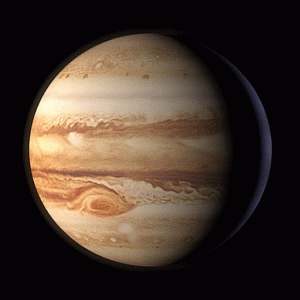
The Planet
Jupiter is by far the largest planet in our Solar System. The Earth could fit inside Jupiter more than 1000 times.
Jupiter is a very stormy planet. There are storms found throughout the atmosphere, and most of the storms seem to never end. The many different cloud formations and storms in the atmosphere also make Jupiter a very colorful planet.
Jupiter’s great red spot, visible in the picture above to the right, is where a giant storm has been raging for at least 300 years. This red spot is also called “The Eye of Jupiter” because of its shape. This storm’s super hurricane winds blow across an area larger than the Earth.
Jupiter is considered a gas giant because it does not have a solid surface. Under its atmosphere is a large liquid ocean of hydrogen and water. What lies in between that ocean and the atmosphere? Actually, there is no in between. The atmosphere slowly gets thicker and thicker until it becomes part of the ocean. In other words, Jupiter’s ocean has no surface on which you could float a boat. The sky becomes the ocean.
Rings
Did you know Jupiter has rings? They are faint and are only able to be viewed when Jupiter passes in front of the Sun. This is because the light from the Sun lights them up for us to see here on Earth. There are three rings in all. They are named Gossamer, Main and Halo.
Moons:
Jupiter has 50 official moons and 12 provisional (unofficial) moons. The four largest and most well-known were discovered by Galileo in the year 1610. Their names are Io, Europa, Ganymede and Callisto. Some of the other moons are Adrastea, Ananke, Carme, Elara, Himalia, Leda, Lysithea, Metis, Pasiphae, Sinope, and Thebe.
You can see four of Jupiter’s moons with a pair of binoculars at night. Also, Jupiter spins really fast; it only takes 10 hours to go from night to day on Jupiter. For that reason, its middle has been stretched out. Rather than round it is short and fat. Kind of like when someone spins pizza dough really fast to stretch it out.
| Why does the moon have so many craters? |
| Answer 1: This is an excellent question! The answer to this question includes important clues about how the Earth, moon, and other rocky planets were formed and about how Earth and the moon are geologically different. Impact craters form when meteorites crash into the surface of a planet. You have already made the good observation that the moon has a lot of these craters. Earth and other planets in our solar system formed about 4.6 billion years ago (that’s a long time). Early in the history of our solar system, asteroid and meteorite impacts were much more common. Our planet and other planets were struck by meteorites thousands of time more frequently than today. That is because back then there was a lot more “stuff” (meteors and planetoids) flying around in our solar system. Over time, those chunks of rock were “caught” by the gravity of big planets. Every time a planet “catches” a meteorite, it gets a crater. This is the same for the moon. In fact, our moon formed when an object the size of a small planet crashed into Earth and tore off a chunk. That chunk was caught by the Earth’s gravity and now orbits it as the moon. So, if Earth was catching meteorites just as often as the moon, why are there many more craters on the moon? The answer is… PLATE TECTONICS!!! Plate tectonics is movement and interaction of “plates” of crust on the surface of our Earth. Plate tectonics is responsible for volcanoes, earthquakes, giant mountain ranges, and the recycling of crust back into the mantle. These processes shape and reshape the surface of Earth very rapidly (geologically speaking, over millions of years). Things like subduction (when crust sinks into the mantle) and erosion (wearing away of rocks at the surface) have erased many of the impact craters on earth. Only very young craters can still be seen. For example, meteor crater in Arizona is about 50,000 years old (that’s really young compared to our planet which is 100,000 times older than this crater). The moon is tectonically “dead”. Plate tectonics no longer happen on the moon, so there is nothing to erase all of the craters. I ended up talking more about the Earth than the moon, but that is because plate tectonics is the big reason that so many impact craters are preserved on the moon. |
| Answer 2: Good question! If the moon and earth are hit with meteors at the same rate, a similar question is: why does the earth have so few craters? A couple of reasons: 1) the earth has a much denser atmosphere than the moon. Incoming meteors cause the air in our atmosphere to compress, rapidly heating it to the point of combustion. This causes the light we see from shooting stars, and cause most small meteors to completely degrade before they touch the surface. The moon, which has very little atmosphere, doesn’t have the same protection. 2) the surface of the earth is constantly changing. From water erosion, plate tectonics, and weather, the surface of the earth is always relatively young on astronomical time scales. In contrast, the moon – with no water or molten core – doesn’t ‘refresh’ its surface at the same rate. Therefore, impact craters from millions of years ago are still very visible. |
| Answer 3: Two reasons: lacking an atmosphere, the moon is unprotected from external projectiles. Second, since there’s little to no erosion on the moon, nothing erases them once they form. Earth would be much more pock-marked by craters, erosion and weathering wasn’t rapidly filling those craters in. |
| Answer 4: The moon’s craters are most likely the result of many asteroids and other space debris (big rocks, etc.) colliding with the moon over the past few billion years. |
| Answer 5: The many craters on the moon are formed mainly because of the collision of asteroids, meteorites with the moon´s surface. Asteroids strike the surface of the moon average speed of 12 miles per second. Earth´s surface also has craters but not nearly as many as the moon because the earth is surrounded by an atmosphere which causes asteroids to burn up before they can reach the surface. The moon does not have an atmosphere so small rocks can collide with its surface. As a result, the moon has many more craters than the earth. The moon´s craters also stay there permanently (or until they are covered by a new crater caused by the collision of another asteroid) as without an atmosphere, there is no wind, rain, erosion, etc. on the moon. The earth´s craters are often deteriorated or washed away by all of these forces. |
| Answer 6: The moon gets pelted by objects in the solar system, and unlike the Earth, the moon has no weather and no plate tectonics that erodes craters away. The Earth would have just as many craters but for the fact that the forces of weather and plate tectonics on Earth fills craters in and destroys them. |
| Answer 7: In the case of the Earth, literally BILLIONS of rocks of all sizes from ones you can hold in your hand to ones the size of Mars! crashed into the PROTO Earth and allowed the Earth to achieve its present day mass!!!!! The craters we see on the MOON are the last bits of evidence of the FINAL major collisions that occurred on the MOON. The same thing happened on EARTH but because the Earth has an atmosphere rain and wind, and because the Earth has active volcanoes and plate tectonics, most of the evidence of these impacts is gone. The Earth does have 150 craters but they are all relatively young… the older craters have been erased!! On the moon, that is not the case. We see craters on the Moon that formed almost four and a half billion years ago!!!! |
A Dwarf Planet is not a planet?
It is very strange to me to deny Pluto the quality of being a planet, and then call it a dwarf planet.
From Wikipedia:
So, isn’t “dwarf” an adjective here? Doesn’t it qualify the noun “planet”? I thought scientists were stickers for precise wording.
A Dwarf Planet is not a planet?
It is very strange to me to deny Pluto the quality of being a planet, and then call it a dwarf planet.
From Wikipedia:
So, isn’t “dwarf” an adjective here? Doesn’t it qualify the noun “planet”? I thought scientists were stickers for precise wording.