Yesterday and today…
We’ve been playing with the abacus, learning about the Orders of Magnitude (what we call each major transition in numbers, as they increase exponentially), and multiplication via sets thanks to a few beads on sticks.
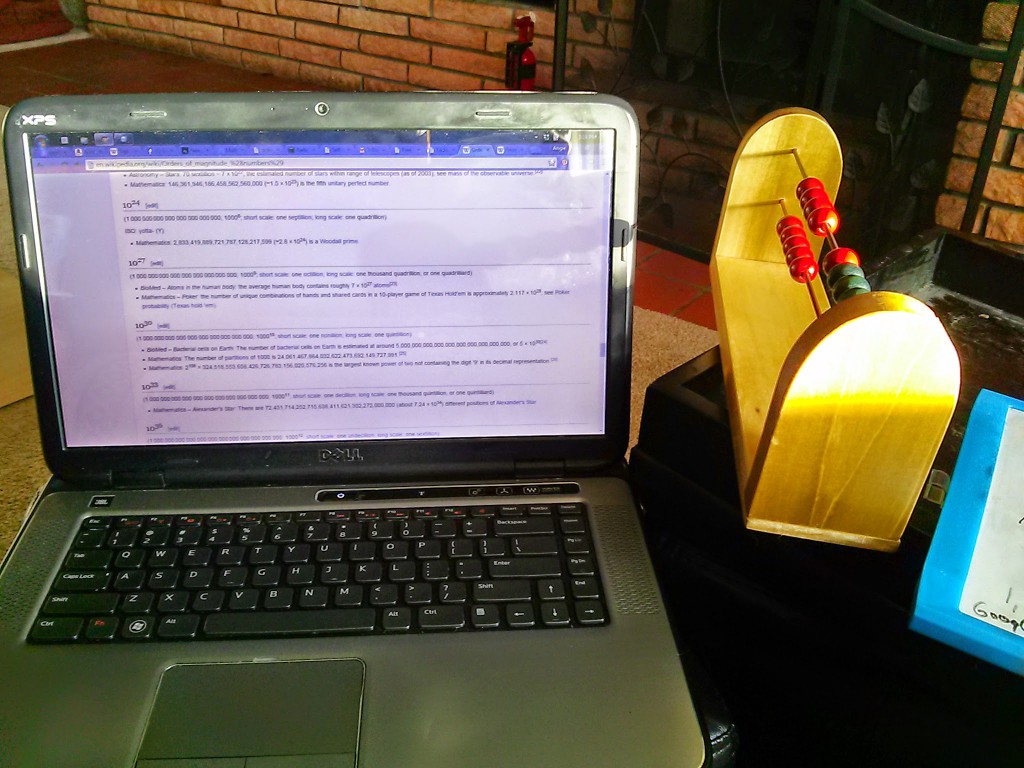
Yesterday, we talked about how, with each added zero, we increase the size/amount of the number. She’s been working to rationalize quantities above a few hundred, as there has been little relevant in her life as of yet much larger than this. She can now recognize each number from 10 to 10e18, which is one quintillion, by the way. She’s identified the pattern of exponents increasing in intervals of three as where we begin to call the number by a new name, and she has identified the pattern of 1, 10, 100, as the associated numbers/intervals for each exponent increase. Oh, and she now has a basic awareness of the concept of an exponent. (We utilized the abacus as a tactile device as we progressed exponentially through the magnitudes.)
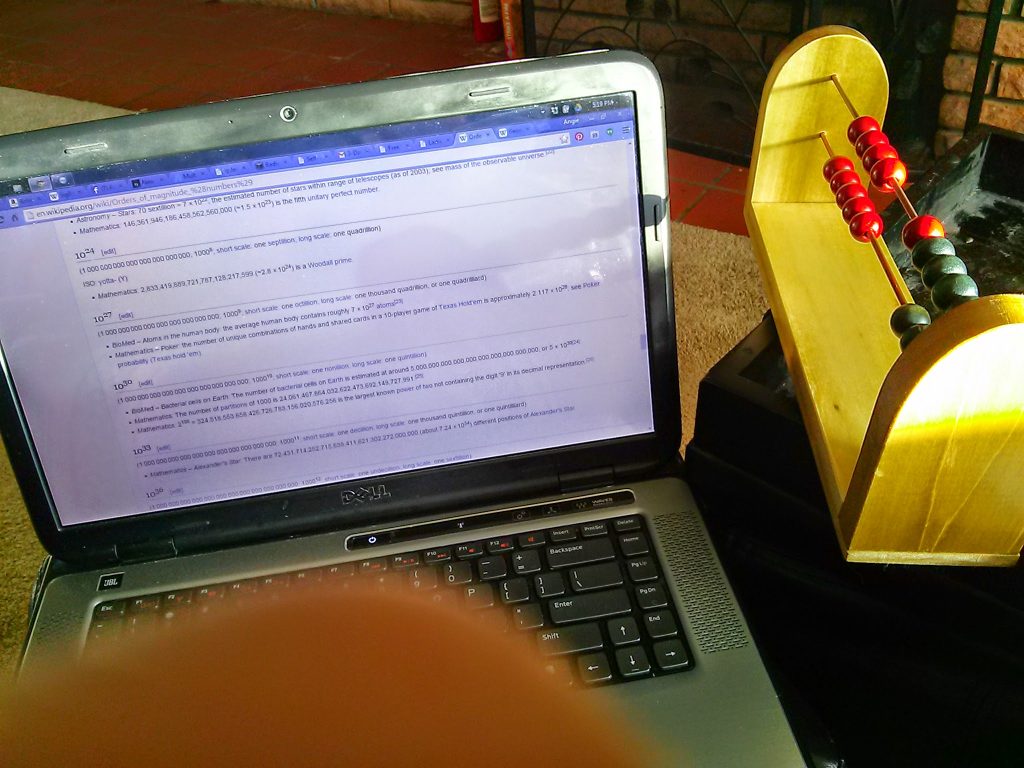
She was able to demonstrate understanding by writing the proper amount of zeros, connecting the numbers to their names as well as power notation.
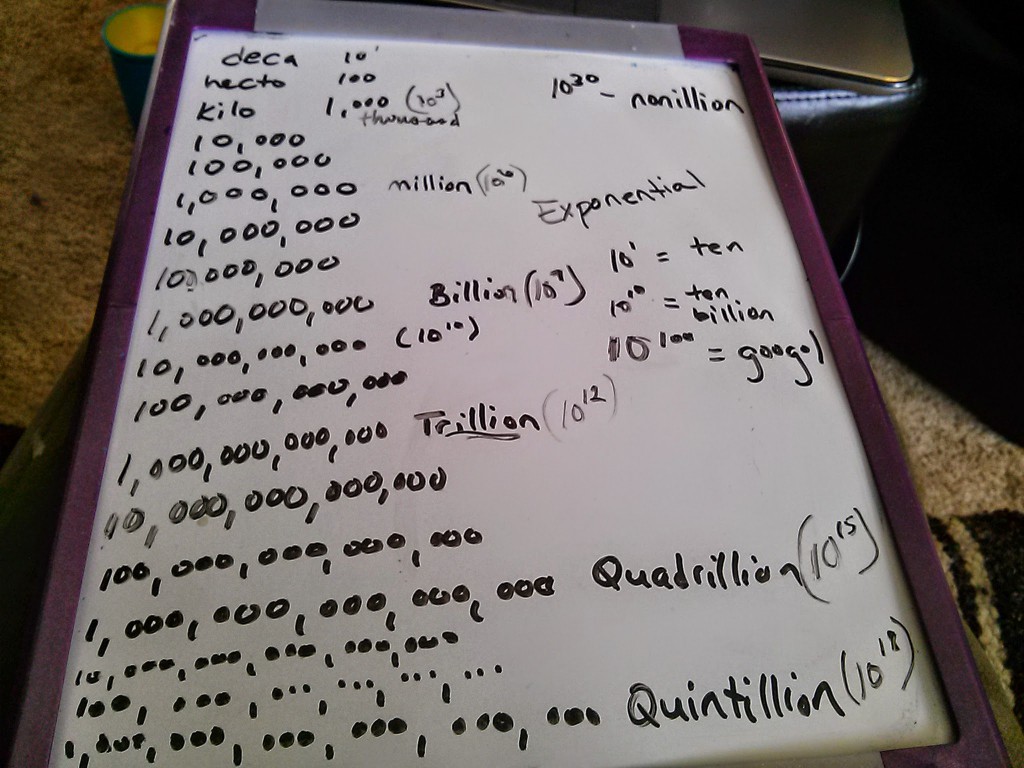
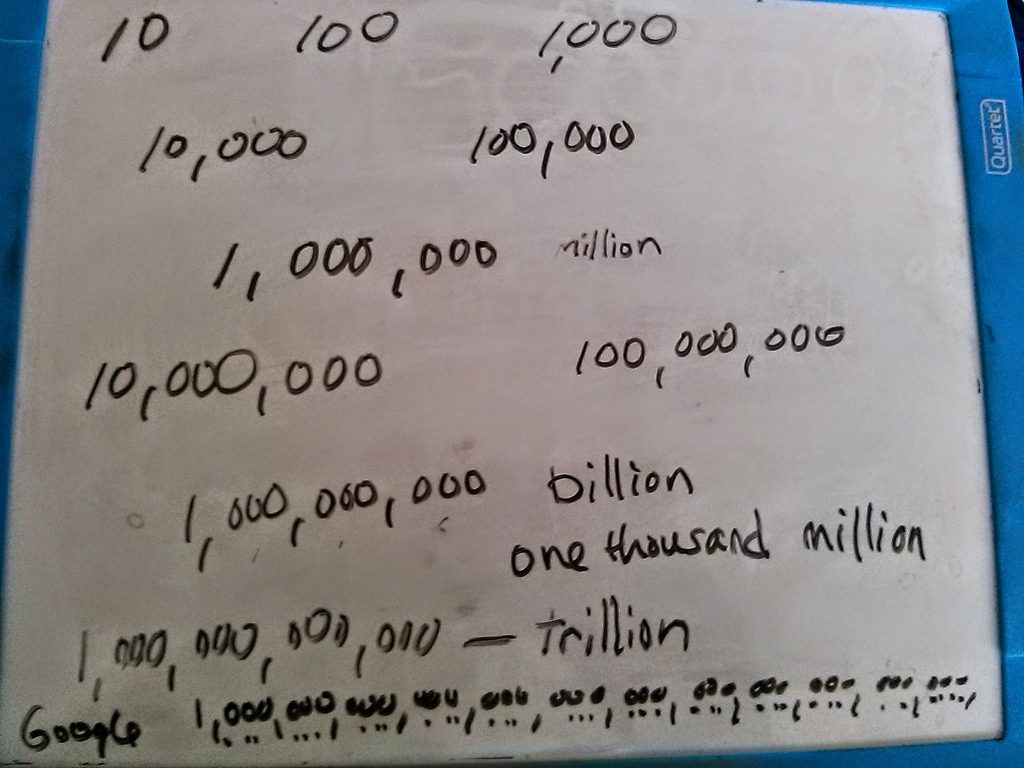
We then read the following, which discusses the concept of a googol and a googolplex, and how a 9 year old invented these names and representation.
Words of wisdom are spoken by children at least as often as by scientists. The name “googol” was invented by a child (Dr. Kasner’s nine-year-old nephew: Milton Sirotta) who was asked to think up a name for a very big number, namely, 1 with a hundred zeros after it. He was very certain that this number was not infinite, and therefore equally certain that it had to have a name. At the same time that he suggested “googol” he gave a name for a still larger number: “Googolplex.” A googolplex is much larger than a googol, but is still finite, as the inventor of the name was quick to point out. It was suggested that a googolplex should be 1, followed by writing zeros until you get tired. This is a description of what would happen if one actually tried to write a googolplex, but different people get tired at different times and it would never do to have Carnera a better mathematician than Dr. Einstein, simply because he had more endurance. The googolplex then, is a specific finite number, with so many zeros after the 1 that the number is a googol. A googolplex is much bigger than a googol. You will get some idea of the size of this very large but finite number from the fact that there would not be enough room to write it, if you went to the farthest star, touring all the nebulae and putting down zeros every inch of the way.
http://books.google.com/books?id=Ad8hAx-6m9oC&lpg=PP1&dq=Mathematics%20and%20the%20Imagination&pg=PP1#v=onepage&q&f=false
Base Number
A number that is to be raised to a power.
Exponent
A number used to indicate how many times to multiply the base by itself.
Exponential Form
A way to write a number or expression in a more compact structure using exponents.
Power
The product obtained by multiplying a number by itself one or more times.
- http://www.mathsisfun.com/algebra/exponent-laws.html
Exponents are shorthand for repeated multiplication of the same thing by itself. For instance, the shorthand for multiplying three copies of the number 5 is shown on the right-hand side of the “equals” sign in (5)(5)(5) = 53. The “exponent”, being 3 in this example, stands for however many times the value is being multiplied. The thing that’s being multiplied, being5 in this example, is called the “base”.
This process of using exponents is called “raising to a power”, where the exponent is the “power”. The expression “53” is pronounced as “five, raised to the third power” or “five to the third”. There are two specially-named powers: “to the second power” is generally pronounced as “squared”, and “to the third power” is generally pronounced as “cubed”. So “53” is commonly pronounced as “five cubed”.
http://www.purplemath.com/modules/exponent.htm
- https://www.khanacademy.org/math/pre-algebra/exponents-radicals/exponent-properties/v/exponent-rules-part-1
SO… We went looking for something that put into perspective the concepts of million, trillion, and googol.
How far is a light-year?
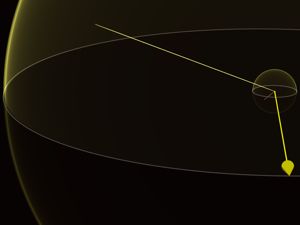
Light is the fastest-moving stuff in the universe. It travels at an incredible 300,000 kilometers (186,000 miles) per second. So, in a year, light travels far.
Stars other than our sun are so far distant that astronomers refer to their distances not in terms of kilometers or miles – but in light-years.
____________________
Light is the fastest-moving stuff in the universe. It travels at an incredible 300,000 kilometers (186,000 miles) per second. That’s very fast. If you could travel at the speed of light, you would be able to circle the Earth’s equator about 7.5 times in just one second!
A light-second is the distance light travels in one second, or 7.5 times the distance around Earth’s equator. A light-year is the distance light travels in one year. How far is that? Multiply the number of seconds in one year by the number of kilometers (or miles) that light travels in one second, and there you have it: one light-year. It’s about 9.5 trillion kilometers (5.88 trillion miles).
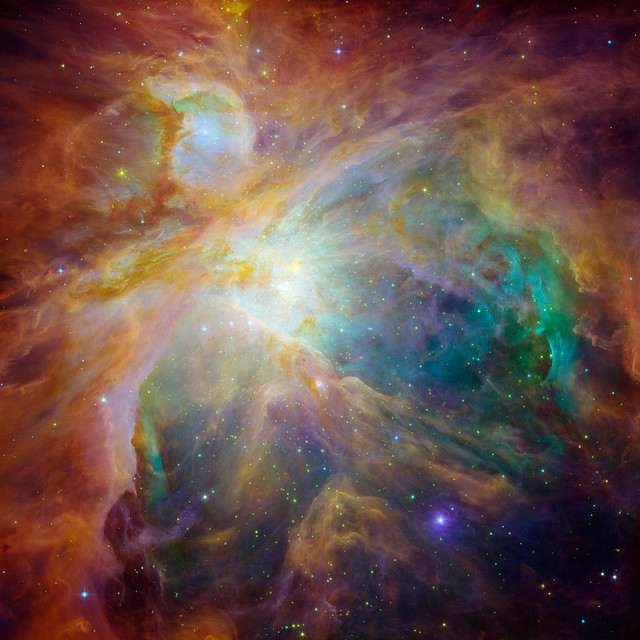
The Orion Nebula, 1,500 light years from Earth
Few of us can comprehend such a humongous number. Is there any way for us mere mortals to really understand how far a light-year is?
As a matter of fact, there is. The 20th century astronomer Robert Burnham Jr. – author of Burnham’s Celestial Handbook – devised an ingenious way to portray the distance of one light-year. He did this by relating the light-year to the astronomical unit – the Earth-sun distance.
One astronomical unit equals about 150 million kilometers (93 million miles).
Another way of looking at it: the astronomical unit is a bit more than 8 light-minutes in distance.
Quite by coincidence, the number of astronomical units in one light-year and the number of inches in one mile are virtually the same. For general reference, there are 63,000 astronomical units in one light-year, and 63,000 inches in one mile. This wonderful coincidence enables us to bring the light-year down to Earth. If we scale the astronomical unit – the Earth-sun distance – at one inch, then the light-year on this scale represents one mile.
What is a light-year?
The closest star to Earth, other than the sun, is Alpha Centauri at some 4.4 light-years away.
Scaling the Earth-sun distance at one inch places this star at 4.4 miles (7 kilometers) distant.
Scaling the astronomical unit at one inch, here are distances to various stars, star clusters and galaxies:
Alpha Centauri: 4 miles
Sirius: 9 miles
Vega: 25 miles
Fomalhaut: 25 miles
Arcturus: 37 miles
Antares: 600 miles
Pleiades open star cluster: 440 miles
Hercules globular star cluster (M13): 24,000 miles
Center of Milky Way galaxy: 27,000 miles
Great Andromeda galaxy (M31): 2,300,000 miles
Whirlpool galaxy (M51): 37,000,000 miles
Sombrero galaxy (M104): 65,000,000 miles
I suspect next, along with the diagram we’re building of the experiment/discovery Eratosthenes provided, we’ll be making a scale model of the sun, the earth, and Alpha Centauri.