This morning, Lils and I had the privilege of learning about circuitry, physics, chemistry, and engineering as it relates to batteries. We love it when such specific opportunities present themselves, and take full advantage to learn and explore.
We bought a set of little LED candle/lanterns and have begun supplying batteries and setting them up. After the first lantern, we tried to put batteries into the second, and found the lantern had an issue. The videos tell the story.
https://drive.google.com/file/d/0BwtlGzQfSfkMbTFWQ0VodEZYRkE/view?usp=sharing Take One – Rough (8*min)
Take Two & Continued
https://drive.google.com/file/d/0BwtlGzQfSfkMOC12NHpQZHc2djA/view?usp=sharing
https://drive.google.com/file/d/0BwtlGzQfSfkMOC12NHpQZHc2djA/view
After we worked out the kinks, we watched the following video, and read these pages:
How do batteries work?
Electricity, as you probably already know, is the flow of electrons through a conductive path like a wire. This path is called a circuit.
Batteries have three parts, an anode (-), a cathode (+), and the electrolyte. The cathode and anode (the positive and negative sides at either end of a traditional battery) are hooked up to an electrical circuit.
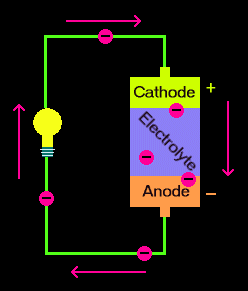
The chemical reactions in the battery causes a build up of electrons at the anode. This results in an electrical difference between the anode and the cathode. You can think of this difference as an unstable build-up of the electrons. The electrons wants to rearrange themselves to get rid of this difference. But they do this in a certain way. Electrons repel each other and try to go to a place with fewer electrons.
In a battery, the only place to go is to the cathode. But, the electrolyte keeps the electrons from going straight from the anode to the cathode within the battery. When the circuit is closed (a wire connects the cathode and the anode) the electrons will be able to get to the cathode. In the picture above, the electrons go through the wire, lighting the light bulb along the way. This is one way of describing how electrical potential causes electrons to flow through the circuit.
However, these electrochemical processes change the chemicals in anode and cathode to make them stop supplying electrons. So there is a limited amount of power available in a battery.
When you recharge a battery, you change the direction of the flow of electrons using another power source, such as solar panels. The electrochemical processes happen in reverse, and the anode and cathode are restored to their original state and can again provide full power.



What’s a circuit?
What does electrically charged mean?


http://www.qrg.northwestern.edu/projects/vss/docs/power/2-how-do-batteries-work.html
And for Papa and I