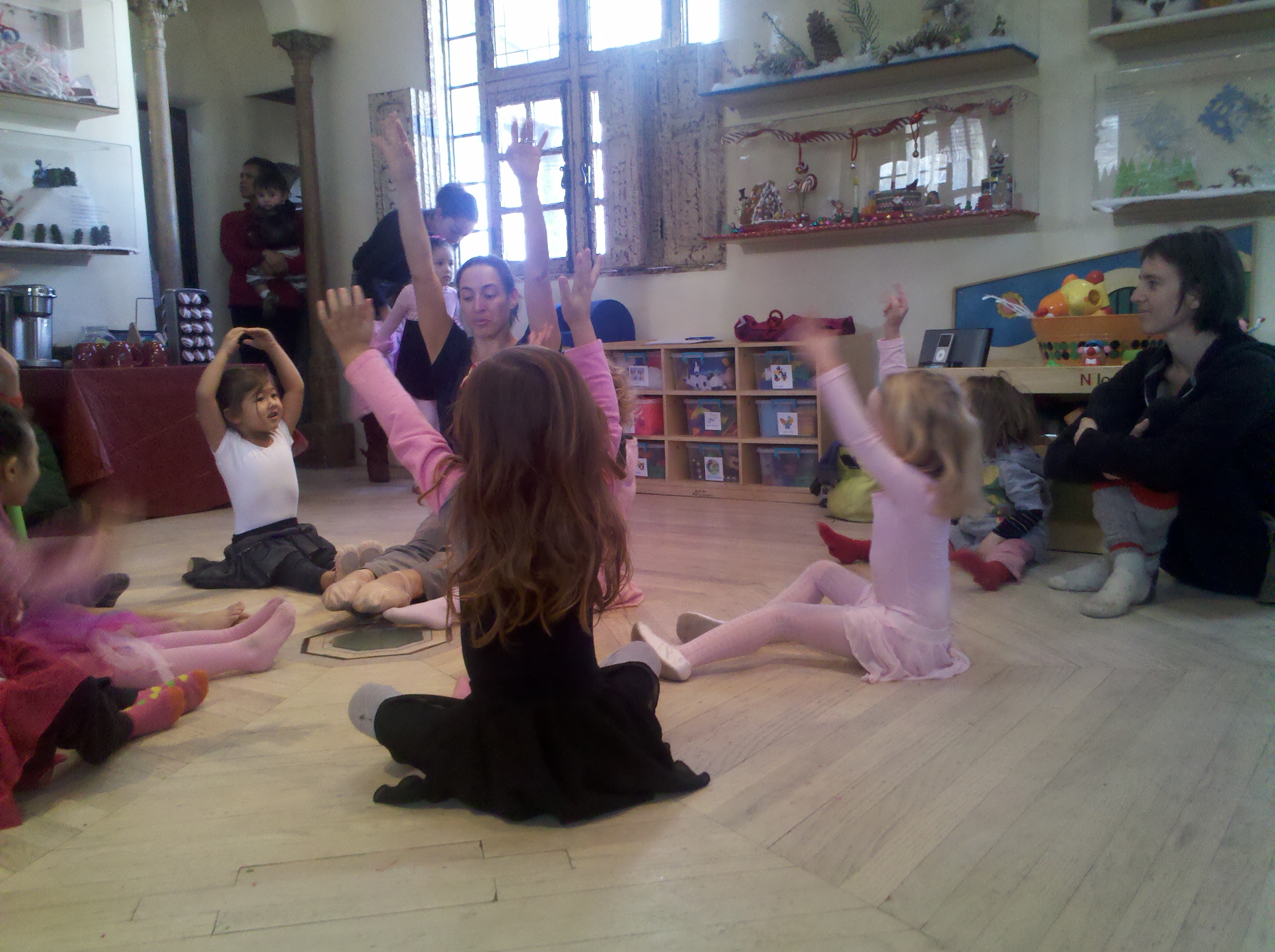
Cecily and I went to her ballet class #2 today. Taos has a drop-in at Twirl and the woman who teaches the class is superb.
The video speaks for itself.. But first, for a bit of reflection for “educational” purposes.
1. Lily has only been to a group activity like this twice now. She has spent a couple sessions now with the preschoolish co-op where she is both the oldest and the only who isn’t one of the group already because her parents are not part of the circle of friends/parents. She does quite well in spite of how little exposure she’s had to group and kid activities.
I had to explain to her the first time we went to the ballet class a few months ago how to follow along in the class and what is expected in an environment like that. Today, with a bit of prodding, she followed along well. A few times she was on her own program, but that is mostly due to her enthusiasm and simple way of ‘knowing’ all of what is going on around her.
In the same thought that she seems to fumble a bit with the other kids and in a class environment, she seems to have a sense of what is going on that rather transcends the moment as she fully connects to the instructor. I watch the other kids who, each in turn, half way or indirectly (no eye contact, no true connection) interact with the instructor. Then I watch mine. When they work with her, they’re just sort of there. When Lily has her attention, it’s as if the two are off in their own world, and their interaction is intense and fluid.
Some might see this as an impediment and weakness, but from my perspective, it indicates two things: Cecily doesn’t belong thrown into the ranks and groups, being shuffled around into the box and expected to disappear into the blur of developing minds. It also dramatically reminds me that Cecily has an intense ability to focus and engage. Given the opportunity with someone (or independently) she then takes the interaction to an even deeper level that is fascinating to watch. She draws such a complete energy out of whomever she’s interacting, fluid and directed, that regardless of the fact that she’s flitting around the room like a ballerina unaffected by gravity when it’s the other kids’ turn, the moment the instructor sets their focus on her, she’s captivated. So is the instructor.
______________________________________________________________
CDE Standards Reference & Analysis
Content Area: Dance
Grade Level Expectations: Preschool
Standard: 4. Reflect, Connect, and Respond
| Prepared Graduates: (Click on a Prepared Graduate Competency to View Articulated Expectations) | |
Concepts and skills students master:
|
|
| Evidence Outcomes | 21st Century Skill and Readiness Competencies |
Students Can:
1. See video shown here, and additional videos posted from today and the previous class a few months back.
2. Cecily uses dance like movements to express: Compassion, tenderness, companionship, grace and elegance, refinement, energy, and intrigue.
– See video of her dancing with ‘Little Sister’ and her Papa for examples
3. Will inquire of her for this
|
Inquiry Questions:
Relevance & Application:
Cecily will draw connections of certain dance movements, sequences, and types with moods, her perceptions of social interaction and purpose, and preference of use of her physical energy.
With no reference to the lack of editorial review of the CDE’s site…
Given this perspective, I intend to encourage Cecily to intentionally express a message of her own devising through a dance, also of her own creation. Nature Of:
|
| Prepared Graduates: (Click on a Prepared Graduate Competency to View Articulated Expectations) | |
Concepts and skills students master:
|
|
| Evidence Outcomes | 21st Century Skill and Readiness Competencies |
Students Can:
Cecily has observed a ballet on PBS’s Great Performances in which there were a variety of dances completed. The one that captured her attention the longest was when a woman danced blindfolded, with one, then two, then a dozen men – never missing a movement, a point, or faltering. She tried to dance blindfolded after she saw this performance.
Cecily uses clapping differently than what is presented here as expectation of social conformity. For Cecily, delight is demonstrated by squeals, intent focus and enthusiastic engagement, mimicry and re-enactment, verbalization and retelling of experience.
I would challenge here that drawing on paper is not necessarily the most effective representation of recognition or comprehension of the value of the movement. Perhaps the exercise demonstrates something currently not obvious to me? Assistance on what the exercise is looking to exhibit would be helpful. – The explanation shown to the right seems disjointed to me. Perhaps I need to research foundational fine motor skills…
|
Inquiry Questions:
Relevance & Application:
I would like to encourage Cecily to be able to recognize the concepts of general behaviors of an audience, for its own sake. I do not agree however that instilling such conformity to social expectation builds foundational self-direction, but rather teaches her what “audience behavior” is – a set of behavioral responses set forth by a societal expectation, that if she chooses to comply, she will have done just that.
Building foundational self direction to us looks more like discipline (not punishment), self regulation because of conscious choice, interpersonal expression, internal processing, autonomy, and integrity. In other words, she chooses her behaviors intentionally – she directs her ‘self’: Conformity to social behaviors is a different subject.
Nature Of:
Thus the concept of artistry and ‘artisanship’… and ‘not often’, but always’- if they have the capacity to think for themselves.
|
Grade Level Expectations: Kindergarten
Standard: 4. Reflect, Connect, and Respond
| Prepared Graduates: (Click on a Prepared Graduate Competency to View Articulated Expectations) | |
Concepts and skills students master:
|
|
| Evidence Outcomes | 21st Century Skill and Readiness Competencies |
Students Can:
1 & 2 – Forthcoming
3 – Conclusive
4 – I will inquire of her
5 – Something we will address. Usage of space is something Cecily is still developing. I’m looking for exercises to encourage her comprehension and space usage both personally and in group interaction.
|
Inquiry Questions:
Relevance & Application:
Is it me, or does this item seem a bit confusing?
I think that discovering a personal connection, or rather being able to identify with something, encourages the development of self awareness, self esteem, and confidence. It also often increases an ability of the given activity or knowledge because of the interest present.
Nature Of:
How? What?
|
| Prepared Graduates: (Click on a Prepared Graduate Competency to View Articulated Expectations) | |
Concepts and skills students master:
|
|
| Evidence Outcomes | 21st Century Skill and Readiness Competencies |
Students Can:
|
Inquiry Questions:
Relevance & Application:
Nature Of:
|